A HIPAA AI voice agent that fills your schedule.
Only 19% of practices use a virtual assistant, while no-shows quietly drain six figures a year. I build the agent that answers, books, and chases. Anything clinical goes to your staff, and that handoff is enforced in code.
30 minutes. The price on this page is the price on the call.
Two-way confirmations by voice. Unreached patients retried, then flagged to staff.
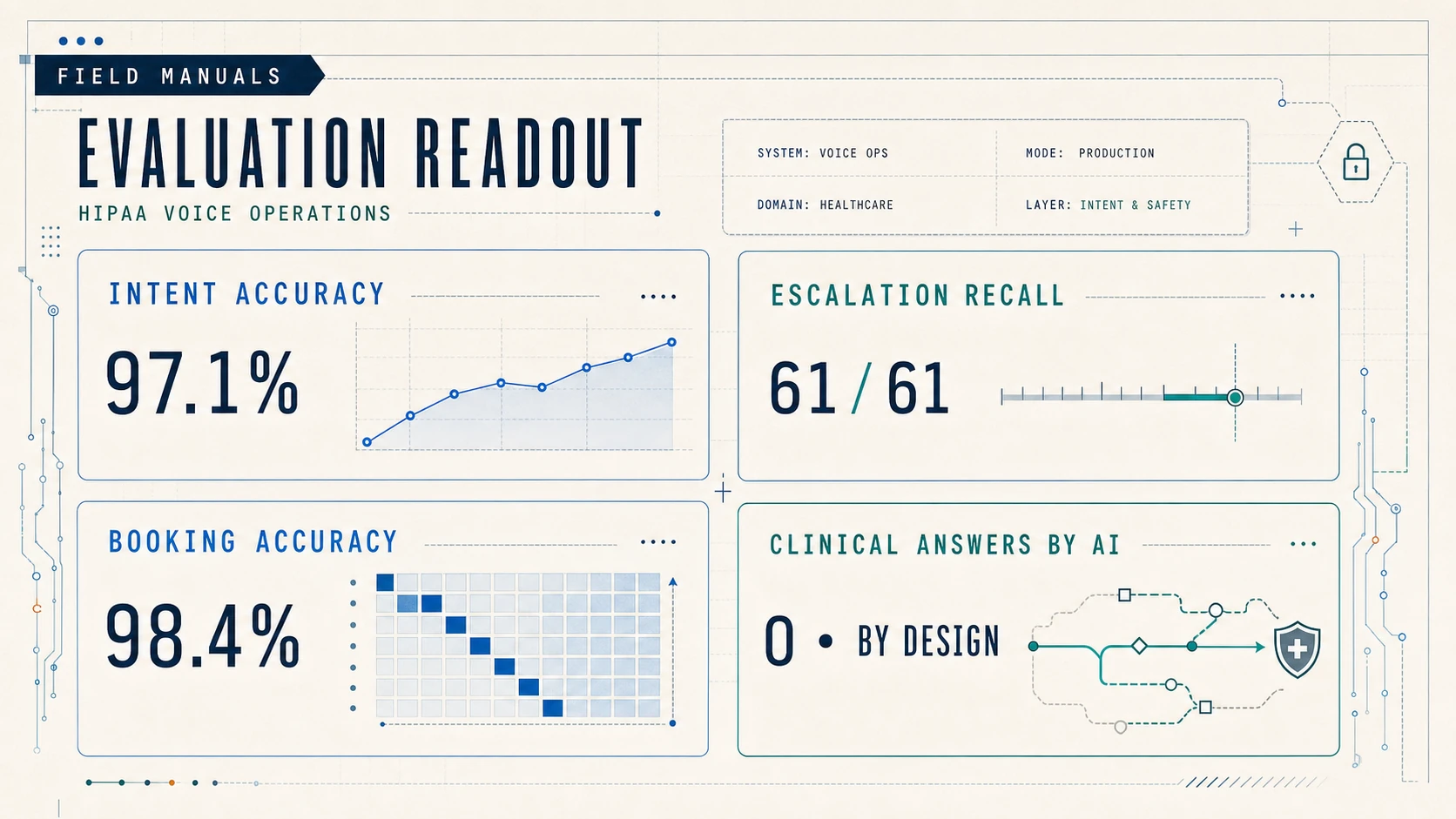
Golden set: your call transcripts · thresholds are contract acceptance criteria · illustrative values
Those numbers describe the same phone line. Reschedule requests go to voicemail at lunch, reminders go out as texts nobody reads, and this morning’s cancellation stays an open slot.
Your phone line leaks $200 at a time
Patient no-shows cost the U.S. healthcare system $150 billion every year. The fix is not exotic: telephone reminders cut no-shows from 21% to 7% in documented cases. But consistent, same-day phone work does not fit inside a front desk that is also checking people in. Every practice has tried some version of three answers:
Add front-desk hours
A loaded staff hour costs more than the calls it covers, and the 6 pm confirmations still don’t happen.
Hire an answering service
Live humans at $1.75 to $2.25 per minute in 2026, plus HIPAA and after-hours surcharges. They take messages. They do not fill your schedule.
Subscribe to a voice-AI platform
The capable ones quote custom and bill forever. The one vendor with public pricing charges from $7,500 for implementation, then meters every completed task at $1.50 or more, permanently.
Own the agent
One build, one price, and the meter never starts. Fixed scope, eval suite included, yours outright.
see the price →A scheduling voice agent, fixed scope, delivered in four weeks
Answer
The agent picks up every inbound call, identifies the caller against your records, and says plainly that it is automated. Anyone who wants a human presses one key and gets one.
Book
It reads and writes your practice-management system: confirms, reschedules, and backfills cancellations from your waitlist, checking every booking against the live schedule before it commits.
Chase
Outbound confirmation calls before every visit, and reactivation calls after a no-show to rebook while the gap still matters. This is the work that moves the no-show number.
The gate
Any clinical question, symptom mention, or medication issue triggers a warm transfer to your staff. The agent does not answer clinical questions, and it cannot be configured to. That constraint lives in code and it is permanent.
human judgmentScope is deliberately narrow: inbound and outbound scheduling calls, one practice-management system, English. That is what makes the price fixed and the timeline honest. Multilingual support or intake capture is a follow-on, priced the same way, in the open.
The eval suite is the product
Every voice-AI vendor claims accuracy and “seamless escalation.” None of them shows you the harness. My acceptance criteria are written into the contract as eval scores, and you keep the machinery that produces them.
Transcript QA golden set
Built from your real call recordings and shadow-period transcripts, not synthetic scripts.
Intent-recognition accuracy
Reschedules, confirmations, cancellations, and insurance questions must be classified correctly against the golden set before the agent takes a live call.
Escalation recall
Every call in the golden set that should reach a human must reach a human. A missed escalation is the failure that matters in healthcare voice AI, so it is the threshold I hold hardest.
Booking-accuracy checks
What the agent said on the call is verified against what landed in the practice-management system.
Shadow-run gate
The agent listens and drafts alongside your front desk before it ever speaks to a patient. Write access comes only after the thresholds clear.
Re-run it anytime
You own the harness, the golden set, the regression suite, and a runbook. You don’t have to trust my accuracy claim: re-run the suite next quarter and after every model update.
This is the whole thesis of my practice: the machine does the work, and the human judges it. A voice agent without a measured escalation gate is a malpractice headline waiting for a dial tone.
The price is $12,000. Here is exactly what it buys.
One price. No tiers, no per-task meter, no quote theater. The number equals the published Year-1 cost of the leading metered alternative, paid once, owned outright.
- Discovery workshop: call taxonomy, escalation rules, where the human gate sits
- Inbound answering agent: caller identification, verification, routing
- Scheduling read/write for one practice-management system
- Outbound reminder and confirmation calling
- Waitlist backfill and post-no-show reactivation flows
- Clinical-escalation gate with warm transfer, enforced in code
- HIPAA controls: BAA chain, encryption in transit and at rest, audit logs, minimum-necessary handling
- Transcript QA golden set built from your calls
- Eval harness: intent accuracy, escalation recall, booking checks, regression suite
- Shadow-run period before the agent takes live calls, with published thresholds
- Handover pack: runbook, eval documentation, your team trained to run the suite
Against the alternatives
| This build | Metered AI platform | Answering service | More front-desk staff | |
|---|---|---|---|---|
| Price | $12,000, once, public | From $7,500 setup + $1.50+ per task, forever | $1.75 to $2.25/min + surcharges | Salary + benefits + turnover |
| Fills the schedule | Yes: books, backfills, reactivates | Yes, while you keep paying | No: takes messages | Yes, during shift hours |
| Who owns it | You: code, evals, golden set | The vendor | Nobody | N/A |
| Proof it works | Eval suite you can re-run | Their dashboard | Call logs | Anecdote |
| Clinical safety | Escalation gate in code, tested | A settings toggle | Human judgment, variable | Human judgment |
I won’t promise your exact no-show reduction; that’s what the shadow run and the first 30 days measure against your own baseline. I will show you the eval scores before the agent takes its first live call.
How the four weeks run
- Week 1
Discovery
Map your call taxonomy and escalation rules, pull recorded calls where your policies allow, set the acceptance thresholds in writing.
- Week 2
Answering + scheduling
Stand up the inbound agent and the practice-management integration, read-only first.
- Week 3
Outbound + the gate
Reminder and reactivation flows, the warm-transfer escalation path, guardrails in code.
- Week 4
Shadow run
The agent drafts alongside your front desk without speaking to patients. We score it against the golden set; live answering switches on only when the thresholds clear.
- Days 1–30
Stabilization
I watch the evals, tune escalation sensitivity, fix drift. Then you own it outright.
Straight answers
The questions every practice owner and office manager asks before booking the call.
Will the AI answer clinical questions?
No, and it can't be configured to. Symptom mentions, medication questions, and anything resembling triage trigger a warm transfer to your staff. The constraint lives in code, and escalation recall on the golden set is a contract acceptance criterion, not a marketing line.
What exactly does the $12,000 include?
Discovery, the answering agent, scheduling integration, outbound flows, the escalation gate, HIPAA controls, the golden set, the eval harness, the shadow run, handover, and 30 days of stabilization. The only costs outside the number are your own telephony and API spend and the optional monitoring retainer.
Is this actually HIPAA compliant?
"HIPAA-ready" platform marketing is not compliance; a signed BAA chain and an audit trail are. The build ships with a BAA covering every vendor in the call path, encryption in transit and at rest, audit logging, and minimum-necessary data handling, all running on accounts you control.
Which practice-management systems do you support?
The build covers one practice-management system; that is what keeps the price fixed. On the call we check whether your system exposes the scheduling access the agent needs. If it doesn't, I'll tell you, and you'll have lost 30 minutes, not a deposit.
Will patients hang up on a robot?
Some will, and the design assumes it. The agent announces it is automated and offers a human on one keypress. The shadow run measures completion: how many calls the agent finishes correctly versus how many need your staff anyway. You see that number before cutover, from your own traffic.
How do you prove it works on our calls, not in a demo?
The golden set is built from your recordings and shadow-period transcripts, and the contract's acceptance criteria are eval thresholds on that set: intent accuracy, escalation recall, booking accuracy. The agent earns write access to your schedule by clearing them. You are never asked to take an accuracy claim on faith.
Why is the price public when every vendor quotes custom or meters per task?
Because scoped work can be priced, and unscoped work shouldn't be sold. The number equals what the one transparent competitor charges for year one of renting; here it buys the machine outright. If discovery reveals your situation needs more, you get a new scope with a number on it before any work starts.
Answer the calls you’re paying to miss.
The no-show math hasn’t changed in years: reminders work, backfill works, and the practices that do both consistently keep the revenue the rest write off. The bottleneck is phone capacity, and phone capacity is exactly what a machine should provide while your staff holds the judgment that matters.
30 minutes · the price stays $12,000 · if it’s not a fit, I’ll say so