Referral management software you own. The priority call stays human.
Faxes, portal PDFs, scanned cover sheets: an AI agent reads every inbound referral, routes it, and tracks it to completion. Your coordinator confirms every clinical priority before anything gets scheduled.
30 minutes. The price on this page is the price on the call.
Below-threshold extractions never auto-fill. They route to a human, by design.
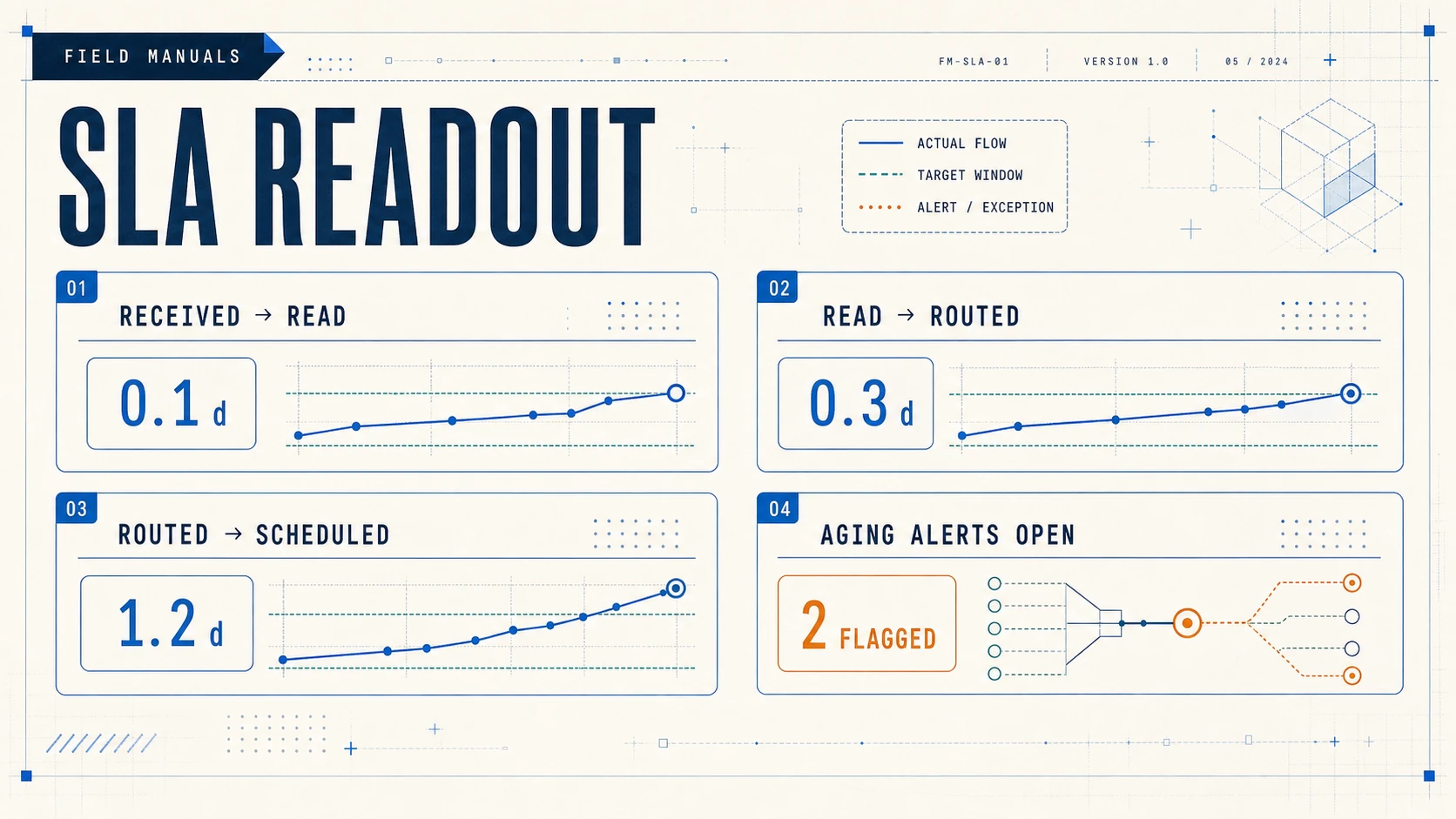
Every referral carries a status and a clock · stalls surface before the referring practice calls · illustrative values
The referrals are already arriving. The leak is in what happens next: someone has to read each one, re-key the details, chase the missing insurance card, decide how urgent it is, and get it scheduled. When volume spikes, the queue silently eats the growth your referring providers are trying to send you.
The fax queue is where referrals go to die
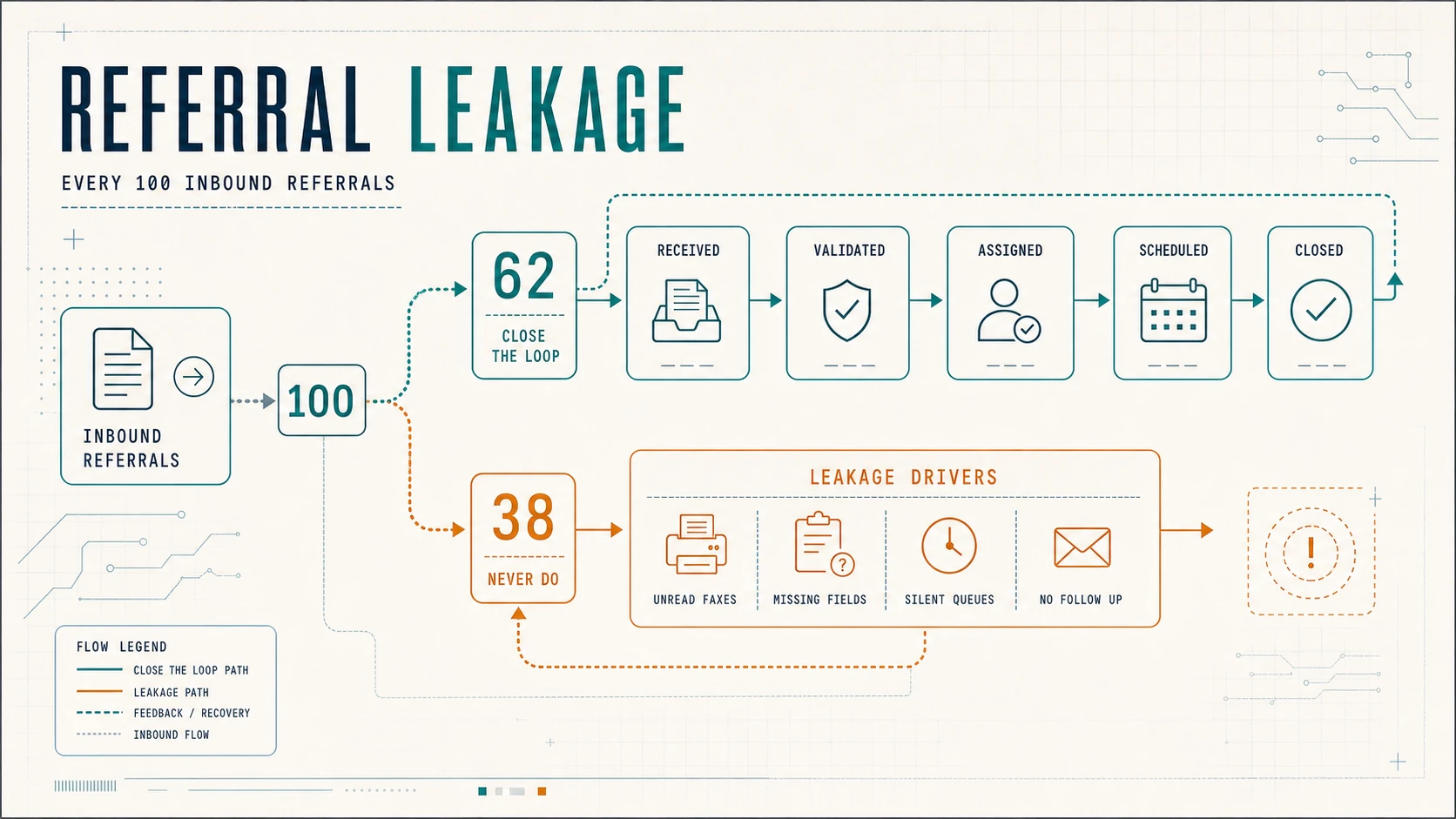
Referral leakage costs US healthcare an estimated $150 billion a year, and 67% of rejected claims trace back to referral or authorization breakdowns. The problem is big enough that investors just put $101 million into Tennr, an AI company that reads faxed referrals for enterprise health organizations. If you are not enterprise-sized, the usual options look like this:
Add another coordinator
Works until they leave, and re-keying faxes is the job nobody stays for. The salary recurs forever; the queue outgrows it anyway.
Rent a referral platform
ReferralMD, HealthViewX, LeadingReach: real products, subscription plus usage fees, and the deployment that actually integrates with your systems is quoted custom. None of them publishes what it costs.
Let the queue ride
The default. Someone will get to the fax pile eventually. This is exactly where the 38% goes.
Own a scoped referral agent
It reads every document, proposes the routing, tracks every referral against a clock, and schedules nothing without a human confirming the priority. Fixed scope, fixed price, eval suite included.
A referral intake and tracking pipeline, delivered in five weeks
- 01
Intake
Document processing reads your inbound referrals (fax, portal PDF, scanned chart fragments) and extracts the fields that matter: patient, referring provider, insurance, reason for referral, urgency markers. No manual re-keying.
- 02
Triage and route
The agent classifies the referral against your specialty's rule-set, checks it for completeness, and drafts the missing-information request when something isn't there. Incomplete referrals stop leaking; they get chased.
- 03
Track
Every referral lands on an SLA board with a status and an aging clock. Nothing sits silently in a queue. When a referral stalls, the board says so before the referring practice calls to ask.
- 04human judgment
The gate
A coordinator confirms the clinical prioritization of every referral before it moves to scheduling. The machine proposes urgency; it never decides it alone. Enforced in code, not in a policy document, and not configurable.
Scope is deliberately narrow: one intake channel set, one specialty's routing rule-set, one practice-management export path. That is what makes the price fixed and the timeline honest. A second specialty or a second site is a follow-on, priced the same way, in the open.
The eval suite is the product
Every vendor in this market claims accuracy. One claims a 90% reduction in incomplete referrals with no methodology shown. My acceptance criteria are written into the contract as eval scores, and you keep the machinery that produces them.
A golden dataset
Built from your historical referrals and how your team actually routed them, not synthetic examples.
Field-extraction tests
Patient, referrer, insurance, and reason fields are scored against the golden set. Extractions below threshold route to a human, by design.
Routing-accuracy regression
The agent's proposed routing is checked against your coordinators' decisions. Drift fails the suite.
Escalation-precision tests
Urgent-flag proposals are measured for both misses and false alarms, because an agent that cries urgent on everything is as useless as one that never does.
A parallel-run gate
The agent works alongside your current process until it clears the thresholds on live referrals. No cutover before the score clears.
$ run evals --suite referral-agent
extraction accuracy96.1% · pass
routing accuracy94.3% · pass
escalation precision91.7% · pass
escalation recall98.2% · pass
regression suite118/121 · pass
scheduled without gate0 · by design
thresholds are contract acceptance criteria · illustrative values
When I hand over, you own the eval harness, the golden dataset, the regression suite, and a runbook. You don't have to trust my accuracy claim. You can re-run it: this quarter, next quarter, after every model update. A referral agent that sets clinical urgency without a measurable human gate is a liability with a nice demo.
The price is $12,000. Here is exactly what it buys.
One price. No tiers, no "starting at," no quote theater.
- Discovery workshop: your referral sources, routing rules, and where the priority gate sits
- Inbound-referral intake pipeline (IDP over fax and portal documents)
- Field extraction: patient, referrer, insurance, reason, urgency markers
- Triage-and-routing agent for one specialty's rule-set
- Missing-information request drafts, human-approved before they send
- Coordinator priority-confirmation workflow (the enforced gate)
- SLA and status tracking board with aging alerts
- Golden dataset built from your historical referrals and routing decisions
- Eval harness: extraction accuracy, routing accuracy, escalation precision, regression suite
- Parallel-run period against your current process, with published thresholds
- Handover pack: runbook, eval documentation, your team trained to run the suite
Against the alternatives
| This build | Enterprise AI platform | Referral SaaS | Another coordinator | |
|---|---|---|---|---|
| Price | $12,000, once, public | Undisclosed; enterprise contract | Subscription + usage fees, quoted custom | Salary + benefits, forever |
| Timeline | 5 weeks + 30-day stabilization | Months of procurement first | Weeks, but never yours | Weeks to hire, months to train |
| Who owns it | You: code, evals, golden set | The vendor | The vendor | Nobody; it walks when they do |
| Proof it works | Eval suite you can re-run | Their accuracy claim | Their case studies | Spot checks |
| Clinical control | Priority gate enforced in code | Varies by configuration | Varies by configuration | Human, but unaided and swamped |
A practice that recovers even a fraction of the referrals currently dying in its queue covers the build cost quickly; how quickly depends on your specialty's economics, and I won't invent a number for it. The parallel run measures what actually changes before you commit to cutover.
How the five weeks run
- Week 1
Discovery
Map your referral sources and routing rules, pull historical referrals and how they were worked, and fix the acceptance thresholds in writing.
- Week 2
Golden dataset + intake
Label historical referrals and routing decisions; stand up document intake and field extraction.
- Weeks 3–4
Triage agent + gate
Routing against your rule-set, the SLA board, the coordinator confirmation workflow, guardrails in code.
- Week 5
Parallel run
The agent works alongside your current process. We compare against the golden set and your coordinators' live judgments. Cutover only when thresholds clear.
- Days 1–30
Stabilization
I watch the evals, fix drift, tune escalation. Then you own it outright.
Straight answers
The questions every practice administrator and ops lead asks before booking the call.
Does the AI decide clinical urgency on its own?
No, and it can't be configured to. The agent proposes a priority with its reasoning attached; a coordinator confirms every referral before it moves to scheduling. The constraint lives in code. Clinical-triage liability is the reason referral automation dies in review, and this design is how the project survives it.
What exactly does the $12,000 include?
Everything in the scope list above: discovery, intake pipeline, extraction, routing agent, SLA board, coordinator gate, golden dataset, eval harness, parallel run, handover, and 30 days of stabilization. The only costs outside the number are your own API/hosting spend and the optional monitoring retainer.
Which intake channels and EHRs are in scope?
One intake channel set (fax/document feed plus portal PDFs) and one practice-management or EHR export path. That is what keeps the price fixed. On the call we check whether your referral mix fits. If it doesn't, I'll tell you, and you'll have lost 30 minutes, not a deposit.
How do you prove it works on our referrals, not just in a demo?
The golden dataset is built from your historical referrals and your team's actual routing decisions, and the contract's acceptance criteria are eval thresholds on that set. Then a parallel run tests it against live referrals before anything cuts over. You are never asked to take an accuracy claim on faith.
Is this HIPAA compliant?
The architecture is BAA-ready: PHI-handling guardrails in code, minimum-necessary extraction, and the option to run on infrastructure you control. Compliance obligations and the BAA itself are scoped in discovery and stated plainly, not hand-waved.
What are the ongoing costs?
Your own LLM API and hosting, typically $150–$500/month at specialty-practice volume, paid on your accounts. Optional monitoring retainer after stabilization: $1,000/month, cancel anytime. There are no per-referral fees, ever.
Why is the price public when every vendor quotes custom?
Because scoped work can be priced, and unscoped work shouldn't be sold. The scope on this page is genuinely fixed, so the price can be too. If discovery reveals your situation needs more, you'll get a new scope with a number on it before any work starts.
Close the loop.
The referrals are already arriving. The question is whether they get worked by a swamped queue or by a machine that reads everything, escalates honestly, and lets your coordinator make the call that matters.
30 minutes · the price stays $12,000 · if it's not a fit, I'll say so