Provider credentialing software you own outright.
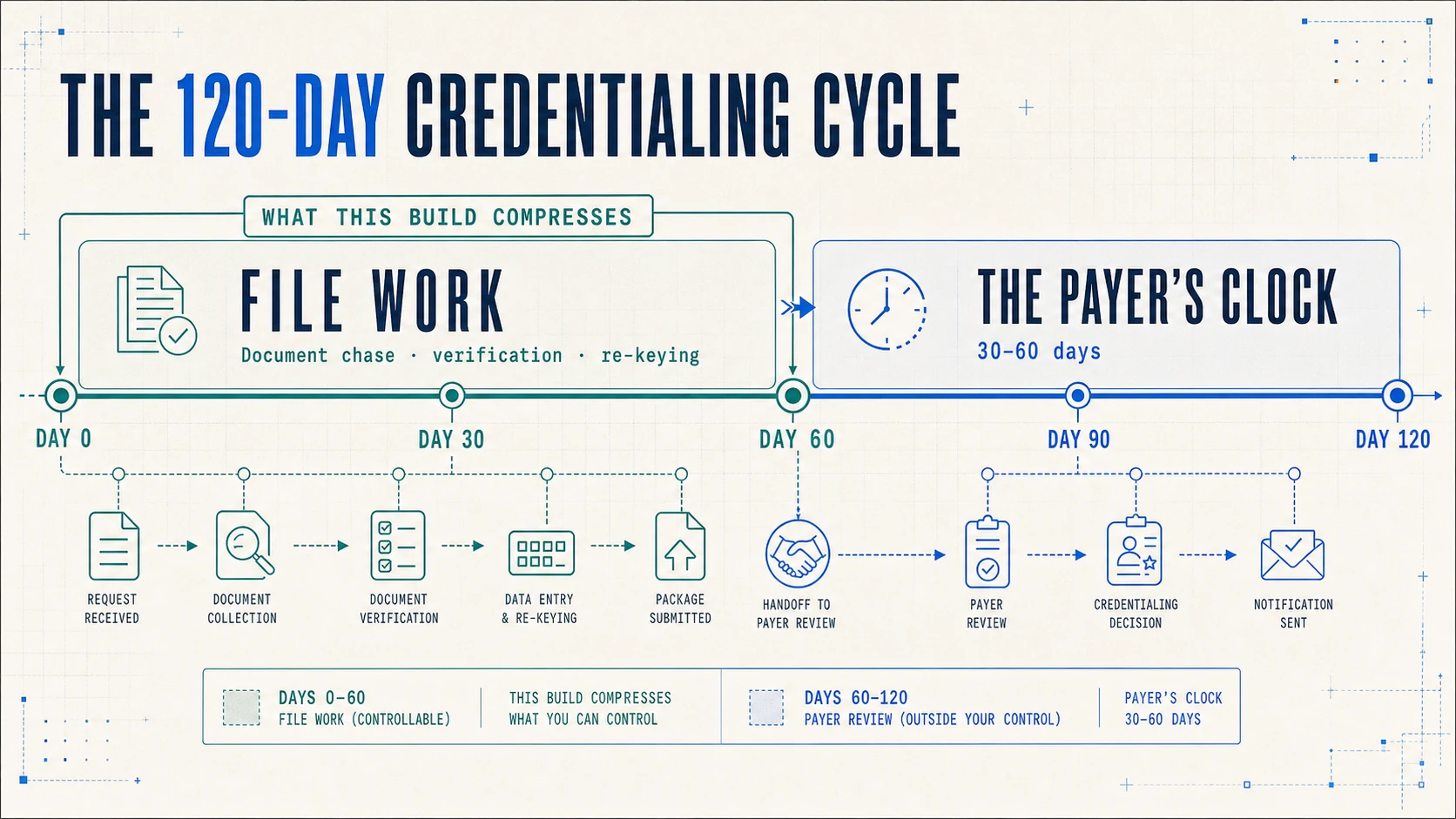
The payer’s review takes 30 to 60 days and you cannot compress it. Everything else is file work, and file work is a machine’s job. Your specialist signs, your committee decides.
30 minutes. The price on this page is the price on the call.
Evidence snapshot saved per check · timestamped · illustrative
Re-credentialing starts before the lapse, not after the audit finding · illustrative
Put those together: a provider you already pay waits three to four months in a queue, at roughly $6,500 a day of idle revenue capacity, while the tools to shorten the wait rent for more per year than this build costs once.
The credentialing queue is a revenue decision
Each application consumes 20+ hours of staff time, and manual primary-source verification eats 4 to 8 weeks of the enrollment window. Here is the shape of the 90-to-120-day cycle, and the only part of it you can actually buy back:
Throw staff at it
Works until volume grows. The specialist who knows every payer’s quirks spends her day copying dates from PDFs into portals.
Rent a platform
Medallion’s median buyer pays $45,634 a year; Verifiable’s median runs $223,333 (Vendr, 2026). Capable systems, priced for health systems, rented forever.
Outsource to a CVO
Commonly $200 to $275 per plan, per provider. The fees recur with every provider and renewal, and the file work never becomes your asset.
Own a scoped credentialing agent
It assembles and verifies every file and submits none of them. Fixed scope, fixed price, eval suite included.
A credentialing pipeline, fixed scope, delivered in six weeks
Intake
Document processing reads licenses, DEA registrations, malpractice certificates, board certifications, CVs, and CAQH exports into one structured provider file, and lists exactly what is missing.
Verify
The agent checks each credential against the primary source. Every check saves a timestamped evidence snapshot, so the file is audit-ready by construction.
Populate
It fills your top five payer application formats from the verified file. The same data, entered once, never re-keyed.
The gatehuman judgment
A credentialing specialist reviews and signs every file before anything is submitted. Enforced in code, not in a policy document. The system cannot submit, and the committee decision stays with the committee.
Scope is deliberately narrow: one provider roster, five primary-source registries, your top five payer application formats. That is what makes the price fixed and the timeline honest. The build also ships an expiry watchlist, so every expirable credential sits on a 90/60/30-day countdown with escalation. More payers, delegated rosters, or extra registries are follow-ons, priced the same way, in the open.
The eval suite is the product
Credentialing is a compliance function. An agent that “usually” gets it right is an audit finding waiting to happen. My acceptance criteria are written into the contract as eval scores, and you keep the machinery that produces them.
Golden provider files
Built from your historical credentialing files and their known outcomes, not synthetic examples.
Document-completeness tests
Every required element for each payer’s checklist, verified per file. A file missing an element cannot reach the gate marked ready.
Verification-match regression
Every extracted field is compared against the primary-source record it claims to match. A mismatch fails the suite.
Expiry-clock tests
The harness advances a synthetic clock and proves the watchlist fires at 90, 60, and 30 days before every expirable credential lapses.
Parallel-run gate
The agent processes files alongside your current process until it clears the thresholds on live applications. No cutover before the score clears.
When I hand over, you own the eval harness, the golden files, the regression suite, and a runbook. You do not have to trust my accuracy claim; you can re-run the suite this quarter, next quarter, and after every model update. This is the whole thesis of my practice: the machine does the work, and the human judges it. In credentialing, the judgment gate is not a nice-to-have. It is the design.
The price is $25,000. Here is exactly what it buys.
One price. No tiers, no “starting at,” no quote theater.
- Discovery workshop: your payer mix, provider types, and where the sign-off gate sits
- Credentialing-document intake pipeline (IDP): licenses, DEA, certificates, CVs, CAQH exports
- Primary-source verification agent across the five registries, with evidence snapshots
- Payer application population for your top five payer formats
- Specialist review-and-sign workflow (the enforced gate)
- Expiry watchlist with 90/60/30-day countdowns and escalation
- Golden dataset built from your historical provider files
- Eval harness: completeness, verification-match, expiry-clock regression
- Guardrails in code: no auto-submission, PII-handling constraints, confidence-floor escalation
- Parallel-run period against your current process, with published thresholds
- Handover pack: runbook, eval documentation, your team trained to run the suite
Against the alternatives
| This build | Platform subscription | CVO service | In-house manual | |
|---|---|---|---|---|
| Price | $25,000, once, public | $45,634/yr median, undisclosed until the quote | $200–$275 per plan, per provider, forever | 20+ staff hours per application |
| Timeline | 6 weeks + 30-day stabilization | Months of procurement first | Fast to start, never yours | The status quo: 90 to 120 days |
| Who owns it | You: code, evals, golden files | The vendor | The vendor | You, minus the tooling |
| Proof it works | Eval suite you can re-run | Their accuracy claim | Their track record | Tribal knowledge |
| Who signs | Your specialist, gate in code | Varies by configuration | Outside your walls | Your specialist, buried in re-keying |
A ten-provider MSO paying per-plan service fees across a dozen payers spends the build cost in a year or two and owns nothing at the end. I won’t promise your enrollment dates; payer review is the payer’s clock. I will show you the eval score before you cut over.
How the six weeks run
- Week 1
Discovery
Map the credentialing workflow, pull historical provider files, fix the payer formats and registries in scope, and set the acceptance thresholds in writing.
- Weeks 2–3
Golden files + intake
Label historical files and outcomes; stand up document intake and the structured provider record.
- Week 4
Verification agent
Primary-source checks across the five registries, evidence-snapshot capture, confidence-floor escalation.
- Week 5
Population + the gate
Payer-format population, the specialist sign-off workflow, the expiry watchlist, guardrails in code.
- Week 6
Parallel run
The agent processes files alongside your current process. We compare against the golden set and live specialist judgments. Cutover only when thresholds clear.
- Days 1–30 after
Stabilization
I watch the evals, fix drift, tune escalation. Then you own it outright.
Straight answers
The questions every MSO operator, credentialing firm principal, and medical staff office asks before booking the call.
Does the agent submit applications automatically?
No, and it can't be configured to. Every file requires specialist sign-off before submission, and the constraint lives in code. Credentialing is a compliance function; the machine assembles and verifies, your people decide.
What exactly does the $25,000 include?
Discovery, document intake, the primary-source verification agent, payer application population, the sign-off gate, the expiry watchlist, golden files, eval harness, parallel run, handover, and 30 days of stabilization. The only costs outside the number are your own API and hosting spend and the optional monitoring retainer.
Which registries and payers are in scope?
Five primary-source registries: state license board, DEA, NPDB, OIG and SAM exclusions, and board certification, plus your top five payer application formats. On the call we check whether your mix fits. If it doesn't, I'll tell you before any money moves.
How do you prove it works on our provider files?
The golden dataset is built from your historical files and outcomes, and the contract's acceptance criteria are eval thresholds on that set: completeness, verification match, and expiry-clock behavior. Then a parallel run tests it on live applications before anything cuts over.
Is this compliant with HIPAA and NCQA-style credentialing standards?
The architecture is BAA-ready, with PII guardrails in code and the option to run on infrastructure you control. Every verification stores a timestamped evidence snapshot, which is what auditors ask for. The credentialing decision itself stays with your specialist and committee, which is what the standards require.
What happens after handover?
You own the code, the golden files, and the regression suite, plus a runbook your team is trained on. Registries change formats and models drift, so re-run the suite on a schedule: yourselves, or through the $1,500 a month monitoring retainer, which you can cancel anytime.
Why is the price public when every platform quotes custom?
Because scoped work can be priced, and unscoped work shouldn't be sold. The scope on this page is genuinely fixed, so the price can be too. If discovery reveals your situation needs more, you'll get a new scope with a number on it before any work starts.
The queue is the cost. Shrink it.
The payer’s clock is theirs. The file work is yours, and it is the part that keeps providers idle for weeks past what the review requires. Assemble it with a machine, verify it at the source, and keep the signature human.
30 minutes · the price stays $25,000 · if it’s not a fit, I’ll say so