Prior authorization automation your staff signs off.
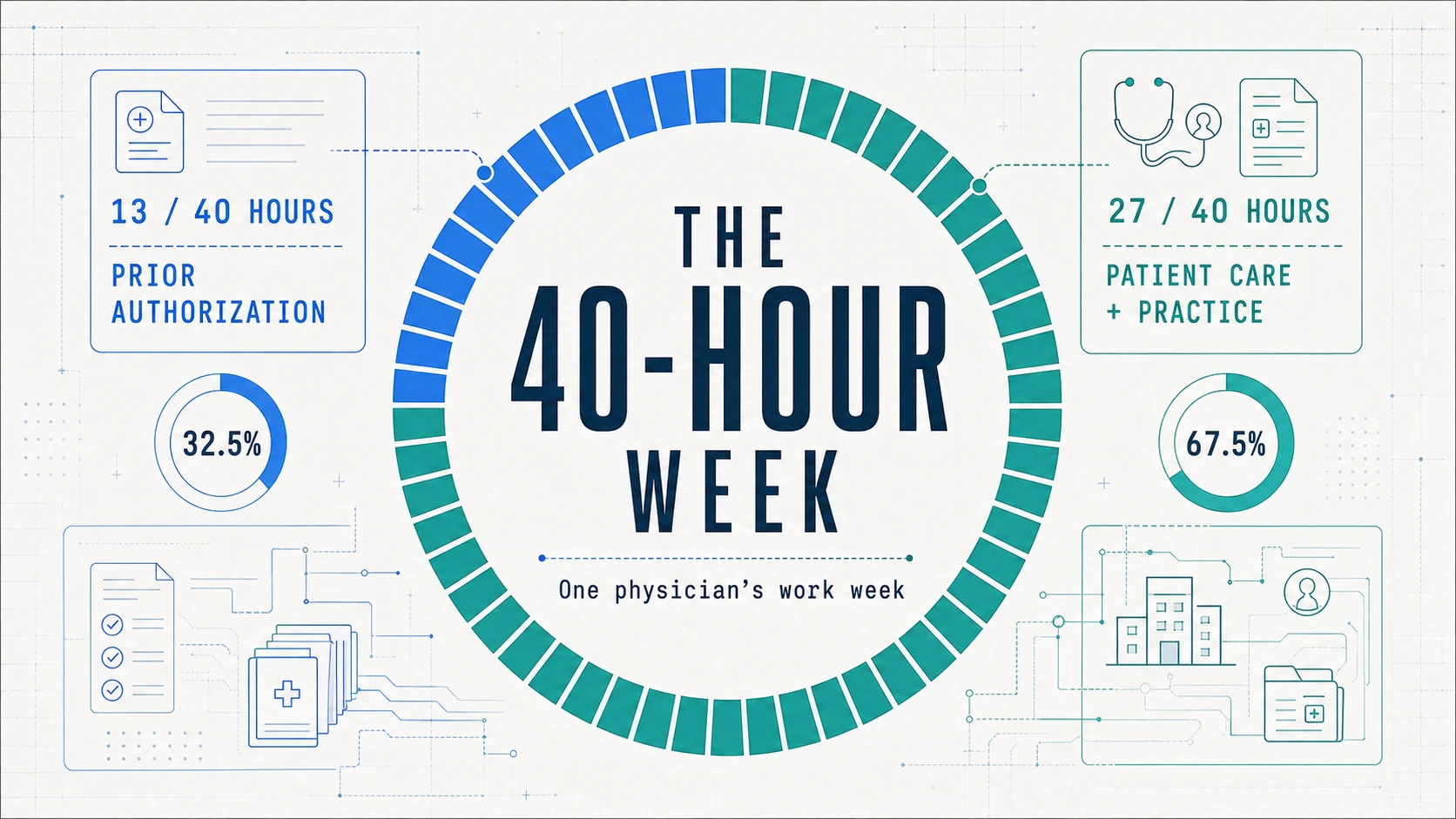
Forty prior auths per physician per week, and thirteen hours of staff time to file them. I build the agent that assembles every request from the chart. Your staff approves what goes to the payer.
30 minutes. The price on this page is the price on the call.
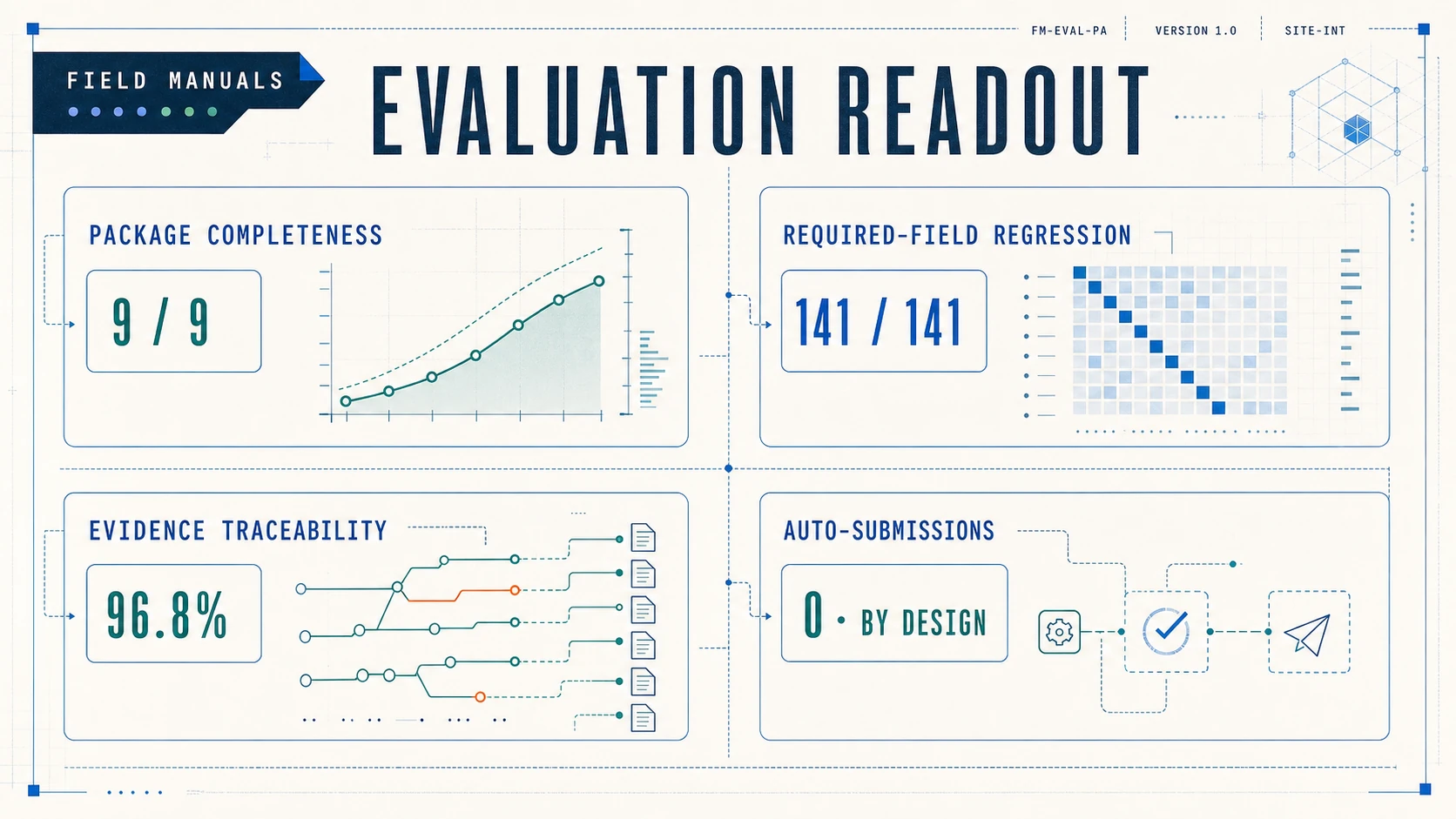
Golden set: your historical PAs · thresholds are contract acceptance criteria · illustrative values
The work itself is mechanical: read the chart, find the evidence the payer’s criteria require, fill the forms, submit, chase. Mechanical work is what a machine should do. The judgment about what goes to a payer under your name should stay human.
Prior auth is a hiring treadmill dressed up as paperwork
94% of physicians say prior auth contributes to burnout, and 40% of practices employ staff who do nothing else (AMA 2025). The volume grows with every new plan rule, and every response to it costs more than it looks.
Own a scoped submission agent
It assembles every request and submits nothing your staff has not approved. Fixed scope, fixed price, eval suite included. MUSC reported an AI agent reclaimed 5,000+ staff hours a month (Medical Economics, 2025); this is that mechanism, owned outright.
A prior-auth submission pipeline, fixed scope, delivered in eight weeks
Read
The agent ingests the chart and the order from one EHR export format, then pulls the clinical evidence your payer’s criteria actually ask for.
Assemble
It maps the payer’s documentation requirements for your service line, builds the submission package, and flags anything missing before a human ever looks at it.
Populate
PA forms and portal fields are filled from the assembled package. Nobody re-keys what the chart already says.
The gatehuman judgment
Your staff reviews and approves every request before it goes to the payer, and a guardrail blocks submission on incomplete evidence. Both enforced in code.
if evidence.incomplete → submission.blocked guardrail · in code payer.submit requires staff.approval gate · in code Neither control can be configured off, at any confidence setting. An agent that files thin PAs creates denials at machine speed; these two lines are why this one can’t.
Scope is deliberately narrow: one payer, one service line, one EHR export format. That is what makes the price fixed and the timeline honest. Additional payers or service lines are follow-ons, priced the same way, in the open.
The eval suite is the product
Every vendor in this market claims speed. Fifty minutes to five. Under 90 seconds. None of them hands you the harness that proves it on your charts. My acceptance criteria are written into the contract as eval scores, and you keep the machinery that produces them.
A golden dataset
Built from your historical prior auths and their outcomes, not synthetic examples.
Completeness checks
Every required element in a submission package must be present and traceable to the chart it came from. Packages with gaps fail the suite.
Required-field regression
When the payer quietly changes a form or a criterion, the suite catches it on the next run instead of your denial rate catching it next quarter.
A parallel-run gate
The agent assembles alongside your current process until it clears the thresholds on live requests. No cutover before the score clears.
When I hand over, you own the eval harness, the golden dataset, the regression suite, and a runbook. You do not have to trust my accuracy claim. You re-run the suite: this quarter, next quarter, after every model update. A submission agent without a guardrail and a measurable gate is a denial generator with good throughput.
The price is $42,000. Here is exactly what it buys.
One price. No tiers, no “starting at,” no quote theater. For scale: that is one prior-auth specialist’s average year, paid once, for a machine you keep.
- Discovery workshop: your PA workflow, the payer and service line in scope, where the staff gate sits
- Chart-and-order ingestion pipeline for one EHR export format
- Payer requirement mapping for one payer and one service line
- Documentation-assembly agent with missing-evidence flagging
- PA form and portal population
- Incomplete-evidence guardrail: submission blocked in code, not in policy
- Staff review-and-approve workflow (the enforced gate) with a full audit trail
- Golden dataset built from your historical prior auths and outcomes
- Eval harness: completeness checks, required-field regression suite
- Parallel-run period against your current process, with published thresholds
- Handover pack: runbook, eval documentation, your team trained to run the suite
Against the alternatives
| This build | Enterprise platform | Per-transaction service | Another hire | |
|---|---|---|---|---|
| Price | $42,000, once, public | Undisclosed; payer-scale contracts | $5 to $15 per PA plus subscription, forever | $43,459 a year, every year |
| Timeline | 8 weeks + 30-day stabilization | Months of procurement first | Fast to start, never yours | Weeks to hire, months to train |
| Who owns it | You: code, evals, golden set | The vendor | The vendor | The process walks out with the person |
| Proof it works | Eval suite you can re-run | Their speed claim | Their speed claim | None |
| Control | Staff gate + evidence guardrail in code | Vendor configuration | Outside your walls | Depends on the day |
A practice running 40 PAs per physician per week across four physicians processes roughly 8,000 requests a year. At per-transaction rates that is a build’s worth of fees every couple of years, and you still own nothing when you stop paying. I will not promise your approval rate; that is what the parallel run measures. I will show you the score before you cut over.
How the eight weeks run
- Week 1
Discovery
Map the PA workflow, fix the payer and service line in scope, pull historical requests and outcomes, and put the acceptance thresholds in writing.
- Weeks 2 to 3
Golden dataset + ingestion
Label your historical PAs and outcomes; stand up chart-and-order ingestion; extract the payer’s requirement rules.
- Weeks 4 to 5
Assembly + population
The documentation-assembly agent, form and portal population, missing-evidence flagging.
- Weeks 6 to 7
The gate + guardrails
Staff review-and-approve workflow, the incomplete-evidence block, the audit trail.
- Week 8
Parallel run
The agent assembles alongside your current process. We compare against the golden set and live staff judgments. Cutover only when thresholds clear.
- Days 1 to 30 after
Stabilization
I watch the evals, fix drift, tune the flagging. Then you own it outright.
Straight answers
The questions every practice administrator and RCM lead asks before booking the call.
Does the agent submit prior authorizations automatically?
No, and it cannot be configured to. Two separate controls live in code: a guardrail that blocks submission when evidence is incomplete, and a staff approval required on every request. An agent that files thin PAs creates denials at machine speed; this design is how the project avoids becoming that.
What exactly does the $42,000 include?
Discovery, chart-and-order ingestion, payer requirement mapping, the documentation-assembly agent, form population, the guardrail and staff gate, the golden dataset, the eval harness, the parallel run, handover, and 30 days of stabilization. The only costs outside the number are your own API and hosting spend and the optional monitoring retainer.
Which payers and service lines are in scope?
One payer and one service line, on one EHR export format; that is what keeps the price fixed. On the call we check whether your highest-volume payer and service line fit. If they don't, I will tell you, and you will have lost 30 minutes, not a deposit.
How do you prove it works on our prior auths, not just in a demo?
The golden dataset is built from your historical requests and outcomes, and the contract's acceptance criteria are eval thresholds on that set. Then a parallel run tests the agent against live requests before anything cuts over. You are never asked to take an accuracy claim on faith.
Is this HIPAA compliant?
The architecture is BAA-ready: PHI-handling guardrails in code, minimum-necessary retrieval, and the option to run on infrastructure you control. Compliance obligations and the BAA itself are scoped in discovery and stated plainly, not hand-waved.
What about CMS-0057-F and the January 2027 API deadline?
The rule already requires 72-hour urgent and 7-day standard decisions, and it mandates payer Prior Authorization APIs by January 1, 2027. The build's assembly and gate layer is payer-API-agnostic: when your payer exposes the mandated FHIR API, the submission path gets simpler, and upgrading the agent to use it is a follow-on priced in the open.
What are the ongoing costs after handover?
Your own LLM API and hosting, typically $200 to $600 a month at practice volume. You own the code, the golden dataset, and the regression suite, so you can run it with no vendor attached. If you want monitoring, it is $2,000 a month, cancel anytime.
The paperwork is not the job. The judgment is.
Prior auth volume is not going down, and hiring against it is a treadmill. The assembly work is exactly what a machine should do, while your staff holds the approval that matters and your evals prove the machine deserves the workload.
30 minutes · the price stays $42,000 · if it’s not a fit, I’ll say so