Patient intake software you own.
The machine reads the cards, IDs, and packets. Your front desk confirms every record before it touches the EHR. Fixed scope, three weeks, one public price.
30 minutes. The price on this page is the price on the call.
6 of 7 fields above threshold · 1 flagged for human review · nothing written yet
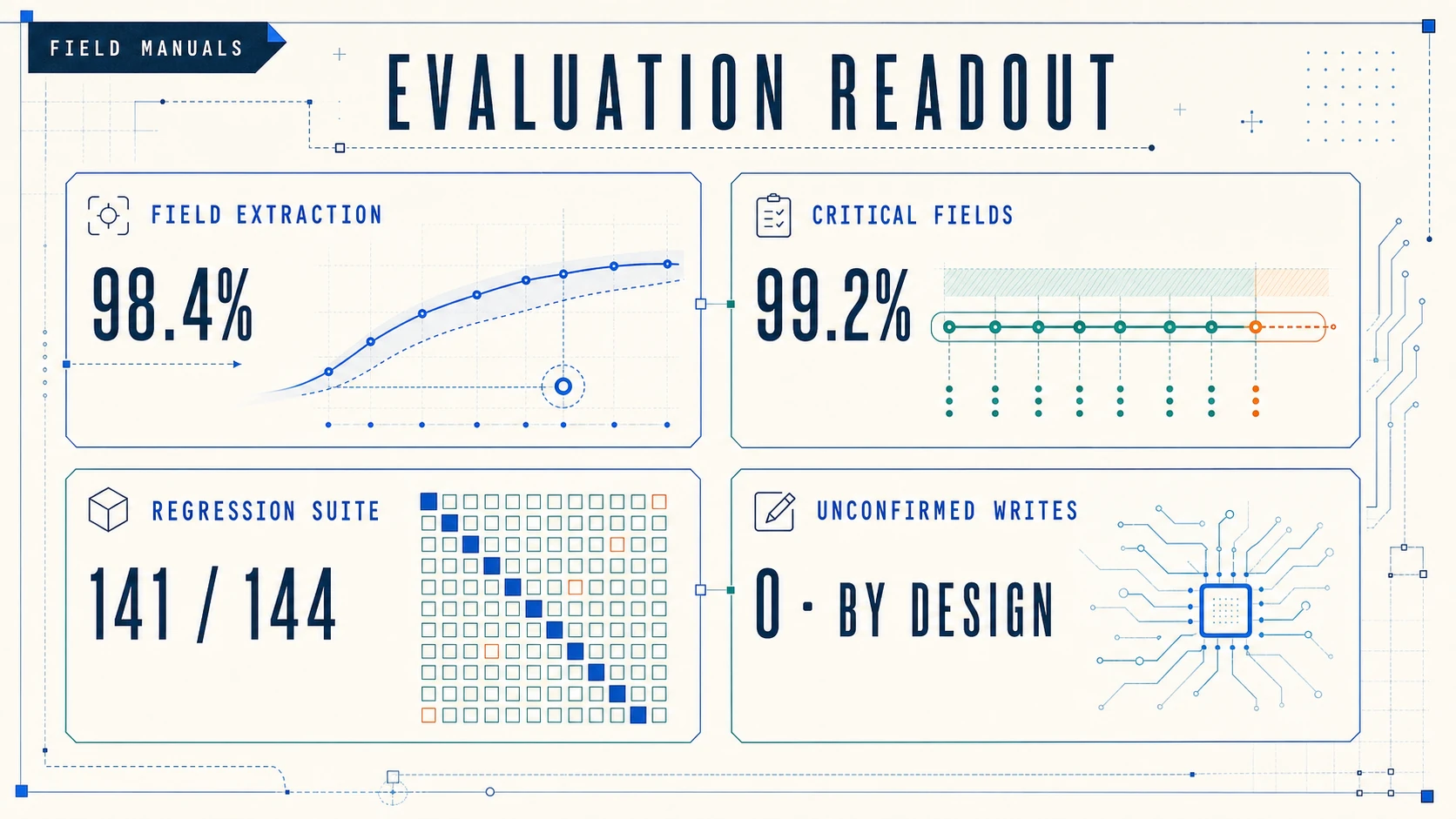
Golden set: your historical intake packets · thresholds are contract acceptance criteria · illustrative values
Follow a denial upstream and you find the same scene: a patient with a clipboard, a front desk employee squinting at handwriting, an insurance card re-typed between phone calls. A transposed member ID costs nothing at 9 a.m. and becomes a denied claim in three weeks.
The clipboard is a denial factory
Manual intake looks like a stationery cost. It is a revenue cost, and the three standard fixes don’t remove it. Digitizing the form, renting a platform, or outsourcing the typing all leave the same keystrokes somewhere in the chain.
IntakeQ-tier tools move the clipboard onto a tablet. Same problem: cards, IDs, and faxed packets still arrive as images, and staff still re-key them.
Phreesia is a capable system. Its pricing page does not contain a price; third-party profiles put deployments at $250 to $1,000+ per month, per provider count and modules.
Data-entry services charge per record forever, your PHI leaves your walls, and quality depends on whoever is staffed this month.
A scoped extraction pipeline that reads the documents itself and writes nothing to the EHR without a human confirming it. Fixed scope, fixed price, eval suite included.
A patient intake pipeline, fixed scope, delivered in three weeks
Capture
Insurance cards, photo IDs, and your intake packet arrive from the scanner, tablet, or fax line. No workflow change for patients or staff.
Extract
An IDP agent reads every document into structured fields: name, DOB, member ID, payer, group number. Each field carries a confidence score.
Map
Extracted fields map to your EHR through one write path: API, HL7/FHIR interface, or structured export.
The gate
A staff member reviews the assembled record and confirms it before anything writes. Enforced in code, not in a policy document. The system cannot write unconfirmed.
Scope is deliberately narrow: one practice location, three document types, one EHR write path. That is what makes the price fixed and the timeline honest. More locations, more document types, or an eligibility check on top are follow-ons, priced the same way, in the open.
The eval suite is the product
Every intake vendor claims accuracy, in demo-gated PDFs you are asked to take on faith. My acceptance criteria are written into the contract as eval scores, and you keep the machinery that produces them.
A golden dataset
Built from your own historical intake packets, cards, and IDs, not from clean synthetic samples. Your handwriting, your fax quality, your payers.
Per-field accuracy tests
Every extracted field is checked against the human-verified truth in the golden set. The suite reports accuracy per field, not one flattering blended number.
Critical-field thresholds
Member ID, date of birth, and payer are held to a stricter bar, because those fields become denials.
Regression suite
Every model update or prompt change re-runs the whole set. Extraction that quietly degrades fails loudly.
A parallel-run gate
The pipeline runs alongside your front desk on live intake until it clears the thresholds. No cutover before the score clears.
When I hand over, you own the eval harness, the golden dataset, the regression suite, and a runbook. You do not have to trust my accuracy claim. You re-run the suite whenever you like: after every model update, every new card format, every quarter. An extraction pipeline without a measurable confirmation gate is bad data moving faster.
The price is $9,000. Here is exactly what it buys.
One price. No tiers, no per-provider meter, no quote theater. For scale: a mid-range intake platform runs roughly $750 a month, which is $9,000 a year, every year. This is that number once, owned.
- Discovery workshop: your intake flow, your document types, where the confirm gate sits
- Document-intake pipeline for insurance cards, photo IDs, and your intake packet
- Field-extraction agent with per-field confidence scores
- Staff confirm-and-write workflow (the enforced gate)
- EHR write path for one system: API, HL7/FHIR, or structured export
- Golden dataset built from your historical intake documents
- Eval harness: per-field accuracy, critical-field thresholds, regression suite
- Guardrails in code: no unconfirmed writes, PHI-handling constraints, low-confidence escalation
- Parallel-run period against your current front-desk process, with published thresholds
- Handover pack: runbook, eval documentation, your team trained to run the suite
Against the alternatives
| This build | Intake platform | EHR-native module | Outsourced data entry | |
|---|---|---|---|---|
| Price | $9,000, once, public | Quote-gated; $250 to $1,000+/mo per provider, forever | Bundled; you pay in roadmap, not invoices | Per record or per hour, forever |
| Reads actual documents | Yes: cards, IDs, packets, with confidence scores | Varies by module | Rarely; forms only | Humans re-key them |
| Who owns it | You: code, evals, golden set | The vendor | The vendor | Nobody |
| Proof it works | Eval suite you can re-run | Demo-gated accuracy claims | None published | None shipped |
| Where PHI goes | Your infrastructure, your accounts | Vendor cloud | Inside the EHR | A third party’s staff |
A clinic spending 11 staff hours a week on re-keying buys those hours back within the first quarter, before counting a single prevented denial. I will not promise your error rate; that is what the parallel run measures. I will show you the score before you cut over.
How the three weeks run
- Week 1
Discovery and golden set
Map the intake flow, collect a sample of your historical cards, IDs, and packets, label the truth, and fix the acceptance thresholds in writing.
- Week 2
Pipeline and gate
Stand up capture and extraction, map fields to your EHR write path, build the staff confirm workflow, wire the guardrails in code.
- Week 3
Parallel run
The pipeline processes live intake alongside your front desk. Output is compared against staff-entered records and the golden set. Cutover only when thresholds clear.
- Days 1–30 after
Stabilization
I watch the evals, fix drift, tune the low-confidence escalation. Then you own it outright.
Straight answers
The questions every office manager and practice administrator asks before booking the call.
Does the AI write directly to the EHR?
No, and it cannot be configured to. Every record requires a staff confirmation, and the constraint lives in code. Bad data flowing silently into charts is why practices distrust intake automation; this design earns the front desk’s trust instead.
What exactly does the $9,000 include?
Everything in the scope list above: discovery, document pipeline, extraction with per-field confidence, confirm gate, EHR write path, golden dataset, eval harness, parallel run, handover, and 30 days of stabilization. The only costs outside the number are your own API and hosting spend and the optional monitoring retainer.
Which document types and EHRs are in scope?
Three document types: insurance cards (front and back), photo IDs, and one intake packet format. One EHR write path: API, HL7/FHIR interface, or structured export. On the call we check whether your stack fits. If it doesn’t, I’ll tell you, and you’ll have lost 30 minutes, not a deposit.
How do you prove extraction accuracy on our documents, not a demo?
The golden dataset is built from your historical intake documents, and the contract’s acceptance criteria are per-field eval thresholds on that set, with stricter bars on member ID, DOB, and payer. A parallel run then tests live intake before cutover. You are never asked to take an accuracy claim on faith.
Is this HIPAA compliant?
The architecture is BAA-ready: PHI-handling guardrails in code, minimum-necessary data flow, and the option to run entirely on infrastructure you control. Compliance obligations and the BAA itself are scoped in discovery and stated plainly, not hand-waved.
What happens after handover?
You own the code, the golden dataset, and the regression suite, plus a runbook your team is trained on. Card formats change and models drift, so re-run the suite on a schedule: yourselves, or through the $800 a month monitoring retainer, which you can cancel anytime.
Why is the price public when Phreesia quotes custom?
Because scoped work can be priced, and unscoped work shouldn’t be sold. One location, three document types, one write path: that scope is genuinely fixed, so the price can be too. If discovery reveals you need more, you get a new scope with a number on it before any work starts.
Stop typing what a machine can read.
The denial statistics all point at the same desk. Reading documents is exactly the work a machine should do; confirming the record is exactly the judgment your staff should keep.
30 minutes · the price stays $9,000 · if it’s not a fit, I’ll say so