An AI medical scribe your practice owns.
The note drafts itself during the visit. Your clinician signs every one before it enters the chart. Pay for the build once, keep the eval suite, skip the per-seat subscription.
30 minutes. The price on this page is the price on the call.
S · history
“Left knee pain improved since starting PT; morning stiffness now under ten minutes.”
O · exam
A/P · plan
Golden set: your visits · thresholds are contract acceptance criteria · illustrative values
The evidence question is settled: ambient scribes give clinicians real time back, measured across thousands of clinicians. The open question is the deal. Every option on the market rents you the machine, per provider, per month, forever.
Documentation is the tax on every visit you run
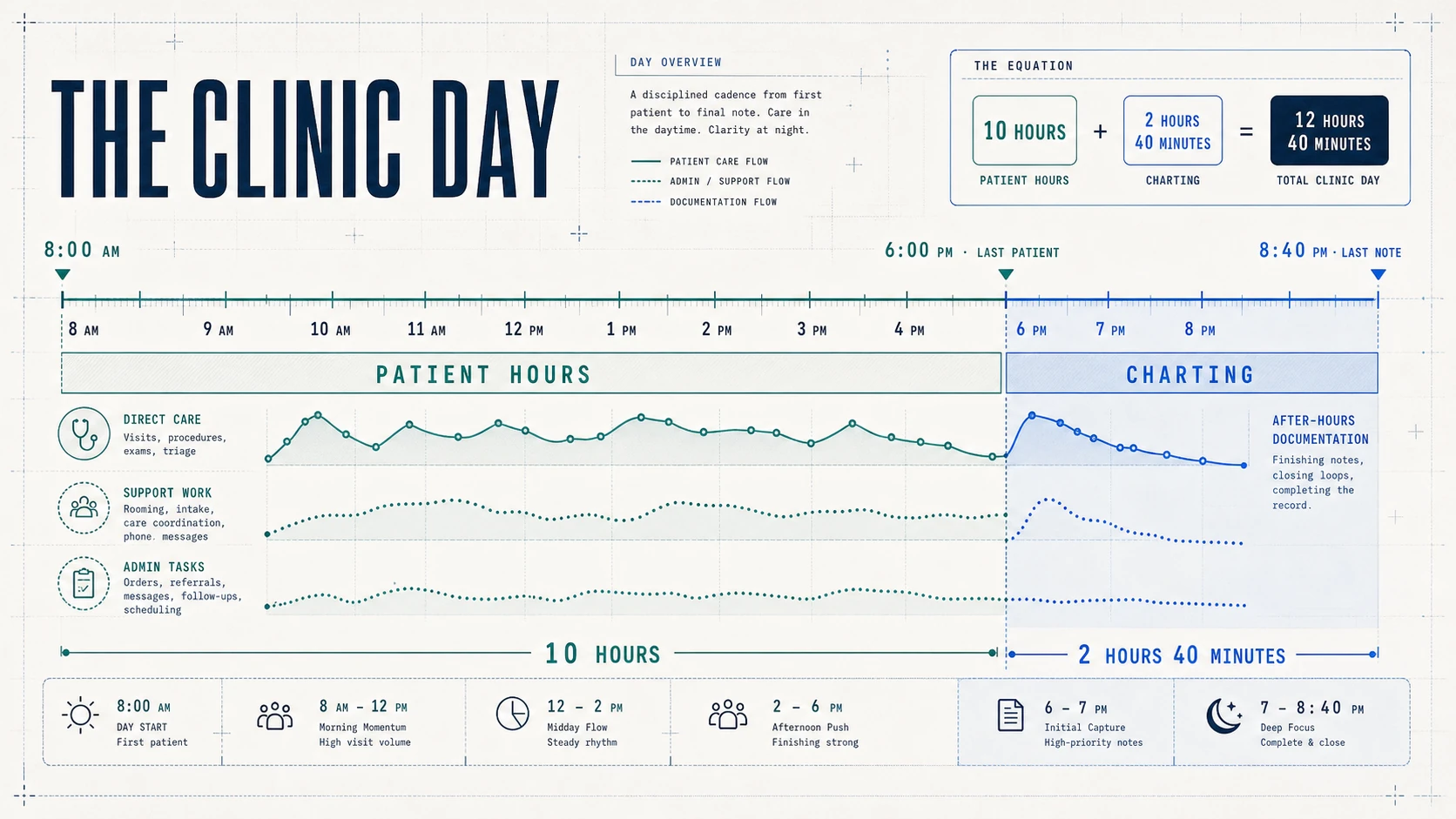
The pattern in small practices is always the same: the last patient leaves at 6:00 pm and the last note gets signed closer to 9:00. A Penn Medicine study found ambient scribes cut in-visit EHR time by 20% and after-hours EHR time by 30%, which tells you exactly where those evenings are going now.
Enterprise ambient
DAX Copilot, Abridge: strong systems sold through health-system contracts, with setups measured in months. Nobody at this tier is built to sell to a three-clinician practice.
Subscription scribe apps
Freed, Heidi, Nabla, Suki: honest value when a generic template fits your charts. But templates lean primary care, per-seat fees never end, and visit audio routes through the vendor’s cloud.
A human scribe
Real judgment in the room, plus hiring, training, turnover, and coverage gaps every time someone calls in sick.
A scribe you own
Pipeline, specialty template, and eval suite: built in four weeks, signed by your clinician on every note, owned outright.
An ambient documentation pipeline, fixed scope, four weeks
Capture
Consented ambient audio, encrypted in transit and at rest, with retention rules you set. Where the audio lives is an architecture decision you control, not a line buried in a vendor contract.
Draft
The agent turns the conversation into a structured note in your specialty’s template: your headings, your phrasing conventions, built from your own reference notes rather than a generic primary-care format.
Omission check
A second pass flags what the transcript said but the note missed: the medication change mentioned in passing, the symptom the patient raised once. Omissions are the failure mode that matters, so the machine hunts them on every note.
The gatehuman judgment
Your clinician reviews, edits, and signs every note before it enters the chart. Enforced in code, not in a policy document. An unsigned note cannot be filed. That constraint is permanent and non-configurable.
Scope is deliberately narrow: one specialty template, one EHR paste or integration path. That is what makes the price fixed and the timeline honest. A second specialty or a multi-provider rollout is a follow-on, priced the same way, in the open.
The eval suite is the product
NEJM AI (2025) found that omissions are the most common AI scribe error type. Vendors advertise how natural their notes sound; the documented failure mode is what the note leaves out. Nobody ships you a way to measure it. This build does, and the acceptance criteria are written into the contract as eval scores.
Golden dataset
Built from your own consented visits and their reference notes, not synthetic demos.
Omission-detection tests
Every clinically relevant statement in the transcript is checked against the draft. Notes that drop findings fail the suite.
Template-conformance regression
Drafts are scored against your specialty template, so the format that took your clinicians years to settle on survives the machine.
Shadow week
The scribe drafts alongside your current process on live visits. No cutover until the thresholds clear.
When I hand over, you own the eval harness, the golden dataset, the regression suite, and a runbook. You do not have to trust an accuracy claim from me or anyone: re-run the suite after every model update and see the score before your clinicians depend on it. The machine does the work, and the human judges it. A scribe without a measurable judgment gate is a liability with a pleasant bedside manner.
The price is $12,000. Here is exactly what it buys.
One price. No tiers, no per-provider seats, no “starting at.” For scale: DAX Copilot reportedly costs a two-clinician practice about $12,000 every year. This is that number once, and you own the result.
- Discovery workshop: your visit flow, your documentation style, where the sign-off gate sits
- Consented ambient capture pipeline with encryption and retention controls
- Specialty note template tuned from your own reference notes
- Structured note drafting agent
- Omission-check pass on every draft
- Clinician review-and-sign workflow (the enforced gate)
- One EHR paste or integration path
- Golden dataset built from your consented visits
- Eval harness: omission detection, template conformance, regression suite
- Guardrails in code: no unsigned note enters the chart, PHI-handling constraints
- Shadow-week parallel run before cutover
- Handover pack: runbook, eval documentation, your team trained to run the suite
Against the alternatives
| This build | Enterprise ambient | Subscription app | Human scribe | |
|---|---|---|---|---|
| Price | $12,000, once, public | Reportedly $369 to $600 per provider per month | $39 to $399 per provider per month, forever | ~$50,000 a year |
| Specialty fit | Template built from your notes | Strong, at enterprise scale | Generic, primary-care leaning | Depends on the hire |
| Who owns it | You: code, template, evals | The vendor | The vendor | Nobody; it walks out the door |
| Proof it works | Eval suite you re-run | Their accuracy claim | Their marketing page | Anecdote |
| Where PHI flows | Infra you control | Vendor cloud, contract terms | Vendor cloud | In the room |
The honest read: a solo primary-care doc whose notes barely need editing should take the $79 app and keep the change. This build is for the practice where the generic template keeps missing what matters, and for owners who have done the per-seat math past year two.
How the four weeks run
- Week 1
Discovery
Map the visit flow and documentation style, collect consented recordings and reference notes, fix the acceptance thresholds in writing.
- Week 2
Capture + template
Stand up the capture pipeline and build the specialty template from your golden notes.
- Week 3
Drafting agent + gate
Note generation, the omission-check pass, the clinician sign-off workflow, guardrails in code, the EHR path.
- Week 4
Shadow week
The scribe drafts on live visits alongside your current process. We compare against the golden set and clinician edits. Cutover only when thresholds clear.
- Days 1–30 after
Stabilization
I watch the evals, fix drift, tune the omission thresholds. Then you own it outright.
Straight answers
The questions every practice owner and office manager asks before booking the call.
Does the AI file notes into the chart automatically?
No, and it cannot be configured to. Every note requires clinician review and sign-off, and the constraint lives in code. The scribe drafts; the clinician decides what enters the record.
What exactly does the $12,000 include?
Discovery, capture pipeline, specialty template, drafting agent, omission checks, the sign-off gate, one EHR path, golden dataset, eval harness, shadow week, handover, and 30 days of stabilization. The only costs outside the number are your own API, transcription, and hosting spend, plus the optional retainer.
Why not just subscribe to a $79-a-month scribe app?
Sometimes you should, and I will say so on the call. The subscription makes sense when a generic template fits your charts. It stops making sense when your specialty's format gets mangled, when per-provider fees compound across seats and years, or when you want visit audio on infrastructure you control.
How do you prove it works on our visits, not in a demo?
The golden dataset is built from your own consented visits and reference notes, and the contract's acceptance criteria are eval thresholds on that set. Then a shadow week tests it on live visits before anything cuts over. You are never asked to take an accuracy claim on faith.
Is this HIPAA compliant? Where does the audio go?
The architecture is BAA-ready: patient consent workflow, encryption in transit and at rest, retention rules you set, and the option to run on infrastructure you control. Compliance obligations and the BAA itself are scoped in discovery and stated plainly.
Which EHRs do you integrate with?
The build includes one EHR path, and the pragmatic floor is a structured paste that works with any system. If your EHR exposes an API for draft notes, we scope direct integration on the call. Deeper two-way integration is a follow-on, priced in the open.
What happens after handover?
You own the code, the specialty template, the golden dataset, and the regression suite, plus a runbook your team is trained on. Models drift, so re-run the suite on a schedule: yourselves, or through the $900-a-month monitoring retainer, which you can cancel anytime.
The evidence is in. The ownership model isn’t.
The JAMA numbers settled whether ambient scribes give clinicians time back. What the market still gets wrong is the deal: every option charges per clinician, per month, for a machine you never own and can never audit. Pay for the build once, keep the evals, and let your clinicians hold the pen that matters.
30 minutes · the price stays $12,000 · if it’s not a fit, I’ll say so