An AI medical coding assistant your coders approve.
The machine reads the note, drafts the codes, and shows its evidence. Your certified coder makes every call, and nothing moves to billing without one.
30 minutes. The price on this page is the price on the call.
Note ¶3: “two chronic conditions reviewed, prescription management continued…”
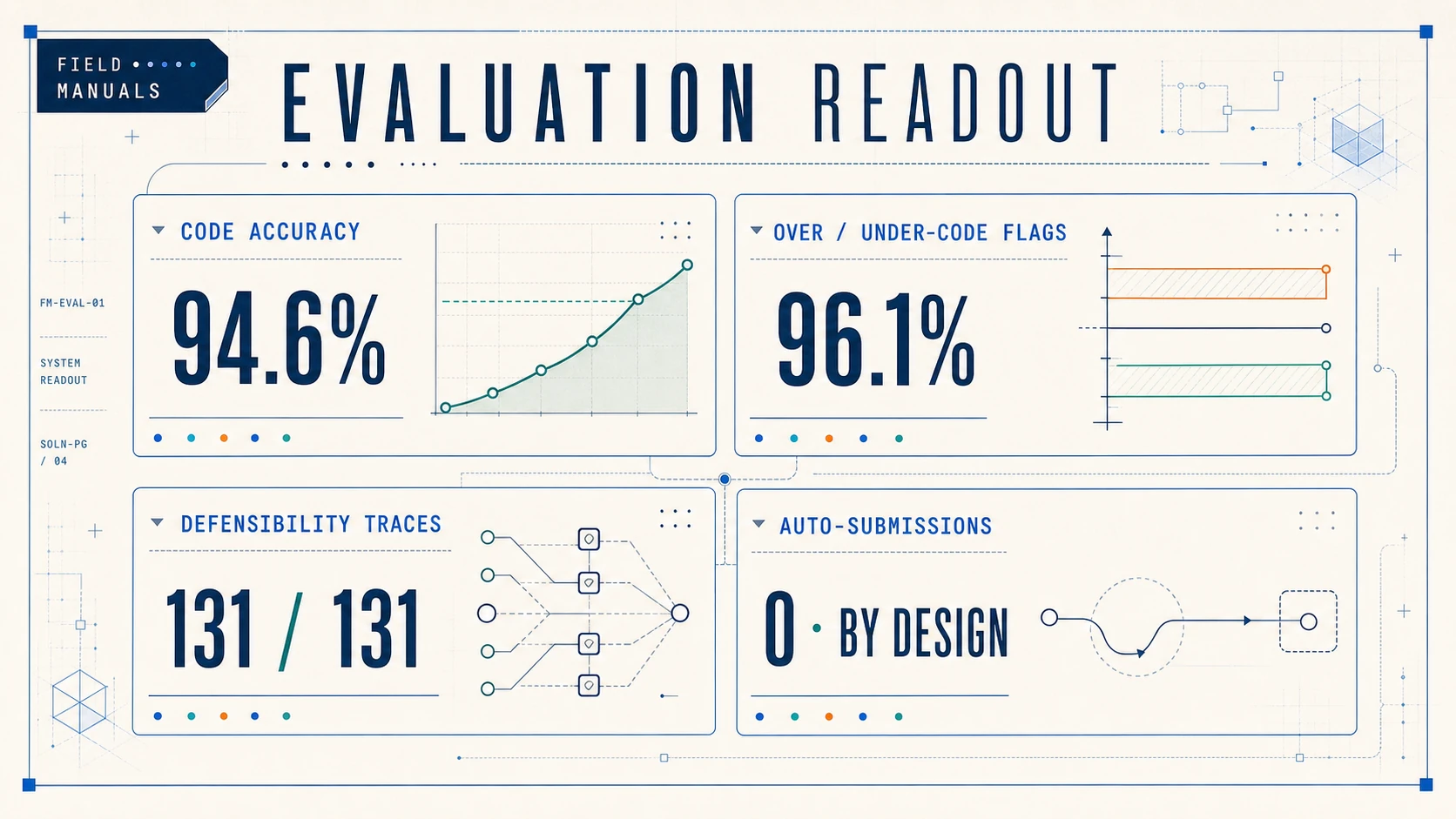
Golden set: your coded and audited charts · thresholds are contract acceptance criteria · illustrative values
Read those numbers together: the leak is measured in billions, coding capacity is priced like a scarce hire, and every miscoded chart went past a human who never had the guideline open at the right paragraph. Throughput is the constraint. Judgment is the asset.
Coding is the bottleneck between care and cash
Nothing bills until it is coded. Code above what the documentation supports and you invite payer audits and paybacks. Code below it and you write off earned revenue silently, chart after chart. Every RCM firm and coding-heavy practice responds one of three ways:
Hire more coders
A first-year hire averages $45,377, still needs seasoning, and the market is short. Capacity that resigns takes its judgment with it.
doesn’t scaleOutsource per chart
Staffed coding services absorb volume, and they charge on every chart, forever. The capability never becomes your asset.
fees foreverRent an autonomous platform
Fathom, CodaMetrix, Nym: serious systems with KLAS awards and enterprise contracts. None publishes a price, and human review is the exception, not the rule.
no public priceOwn a scoped coding assistant
It drafts every code and submits none of them. Fixed scope, fixed price, eval suite included.
A CPT/ICD suggestion pipeline, fixed scope, delivered in seven weeks
- 01
Ingest
The pipeline reads your chart and note exports (one EHR export format) and assembles encounter context with no manual re-keying.
- 02
Retrieve
A RAG layer over the current CPT and ICD-10-CM guidelines, NCCI edits, and your payers’ policies for one specialty pulls the rules that govern the chart in front of it.
- 03
Suggest
The agent drafts the code set with a rationale per code: the note evidence it relied on, the guideline passage that supports it, and a flag wherever documentation supports a higher or lower level.
- 04
The gatehuman judgment
A certified coder reviews, edits, and approves every code before anything moves to billing. Enforced in code, not in a policy document. The system cannot submit. That constraint is permanent and non-configurable.
Scope is deliberately narrow: one specialty, one EHR export format, that specialty’s core CPT and ICD-10 code families. That is what makes the price fixed and the timeline honest. Expansion is a follow-on, priced the same way, in the open.
The eval suite is the product
Every vendor in this market claims an accuracy number. None hands you the machinery to verify the claim on your own charts. My acceptance criteria are written into the contract as eval scores, and you keep the machinery that produces them.
A golden dataset
Built from your historically coded charts, including those that survived or failed payer audits. Not synthetic examples.
Code-accuracy regression
Suggestions scored against the golden set, per code family, with over-coding and under-coding tracked separately. Exact-match alone hides the errors that trigger audits.
Audit-defensibility tests
Every suggested code must trace to note evidence and current guideline text. A code without a defensible trace fails the suite, whatever the aggregate accuracy says.
Update regression
ICD-10 changes every October 1 and CPT every January 1. The suite re-runs after each release, so you find the drift before a payer does.
A parallel-run gate
The assistant runs alongside your coders on live charts until it clears the thresholds. No cutover before the score clears.
When I hand over, you own the eval harness, the golden dataset, the regression suite, and a runbook. You do not have to trust my accuracy claim, or anyone’s. Re-run the suite: this quarter, next quarter, after every model update. A coding engine without a measurable judgment gate is an audit finding waiting for a date.
The price is $32,500. Here is exactly what it buys.
One price. No tiers, no “starting at,” no quote theater.
- Discovery workshop: your specialty code map, your top denial-driving codes, where the coder gate sits
- Chart and note intake pipeline for one EHR export format
- Guideline RAG: CPT, ICD-10-CM, NCCI edits, and your payer policy set for one specialty
- Code-suggestion agent with per-code rationale and evidence links
- Coder review-and-approve workflow (the enforced gate)
- Golden dataset built from your historically coded and audited charts
- Eval harness: code accuracy, over/under-coding detection, audit-defensibility traces
- Guardrails in code: no auto-submission, PHI-handling constraints, confidence-floor routing to your coder
- Parallel-run period against your current coding process, with published thresholds
- Handover pack: runbook, eval documentation, your team trained to re-run the suite
Against the alternatives
| This build | Autonomous platform | Outsourced coding | Another coder hire | |
|---|---|---|---|---|
| Price | $32,500, once, public | Undisclosed; enterprise contracts | Per-chart fees, forever | $65,007/yr average, plus benefits |
| Timeline | 7 weeks + 30-day stabilization | Months of procurement and integration | Fast, but never yours | Months to recruit in a shortage |
| Who owns it | You: code, evals, golden set | The vendor | The vendor | Capacity that can resign |
| Proof it works | Eval suite you can re-run | Their case study, their KLAS badge | Sample audits | A certification and an interview |
| Coder control | Every code approved by your coder | Exception-based review | Outside your walls | Full, but throughput-capped |
For an RCM firm the economics multiply: one owned build, deployed across every practice you code for, with the same eval suite proving it on each client’s charts. I will not promise your accuracy number; that is what the parallel run measures. I will show you the score before you cut over.
How the seven weeks run
- Week 1
Discovery
Map the coding workflow, pull historically coded charts and audit outcomes, fix the code families in scope and the acceptance thresholds in writing.
- Weeks 2–3
Golden dataset + guideline RAG
Label the historical charts, ingest CPT, ICD-10-CM, NCCI edits, and payer policies, stand up the intake pipeline.
- Weeks 4–5
Suggestion agent + gate
Per-code rationale with evidence links, the coder review-and-approve workflow, guardrails in code.
- Weeks 6–7
Evals, then parallel run
Harden the suite against the golden set, then run the assistant alongside your coders on live charts. Cutover only when thresholds clear.
- Days 1–30 after
Stabilization
I watch the evals, fix drift, tune the confidence floors. Then you own it outright.
Straight answers
The questions every coding manager and billing-firm operator asks before booking the call.
Does the AI code and submit charts automatically?
No, and it cannot be configured to. Every code requires certified-coder approval before it moves to billing, and the constraint lives in code. Autonomous submission is how coding tools end up in audit findings; suggestion plus human judgment is how they survive them.
What exactly does the $32,500 include?
Everything in the scope list above: discovery, intake, guideline RAG, suggestion agent with rationale, coder gate, golden dataset, eval harness, parallel run, handover, and 30 days of stabilization. The only costs outside the number are your own API and hosting spend and the optional monitoring retainer.
How do you prove accuracy on our charts, not in a demo?
The golden dataset is built from your historically coded and audited charts, and the contract's acceptance criteria are eval thresholds on that set. Then a parallel run tests the assistant against your coders on live charts before anything cuts over.
Which specialties and EHR formats are in scope?
One specialty and one EHR export format per build; that is what keeps the price fixed. On the call we check whether your specialty mix, note quality, and export path fit. If they don't, I'll tell you, and you'll have lost 30 minutes, not a deposit.
Is this HIPAA compliant?
The architecture is BAA-ready: PHI-handling guardrails in code, minimum-necessary retrieval, and the option to run on infrastructure you control. Compliance obligations and the BAA itself are scoped in discovery and stated plainly, not hand-waved.
What happens when ICD-10 and CPT code sets update?
ICD-10-CM updates every October 1 and CPT every January 1, and that is when un-evaluated coding tools quietly rot. The suite you own includes update regression: refresh the guideline corpus, re-run the tests, read the diff. Do it yourselves from the runbook, or the $2,000/month retainer covers it, cancel anytime.
Why is the price public when every vendor quotes custom?
Because scoped work can be priced, and unscoped work should not be sold. The scope on this page is genuinely fixed, so the price can be too. If discovery reveals your situation needs more, you get a new scope with a number on it before any work starts.
Suggestion is automation. Submission is judgment.
The autonomous-coding vendors are racing to raise the percentage of charts no human touches. The number that wins audits is different: the percentage of suggested codes your coder can defend, with the evidence attached. That number is measurable, and the machine that produces it is buyable, once.
30 minutes · the price stays $32,500 · if it’s not a fit, I’ll say so