Insurance eligibility verification software you own.
The coverage surprise at check-in becomes a denial 30 days later. I build the machine that verifies every patient before the visit. Your staff handles the exceptions, and only the exceptions.
30 minutes. The price on this page is the price on the call.
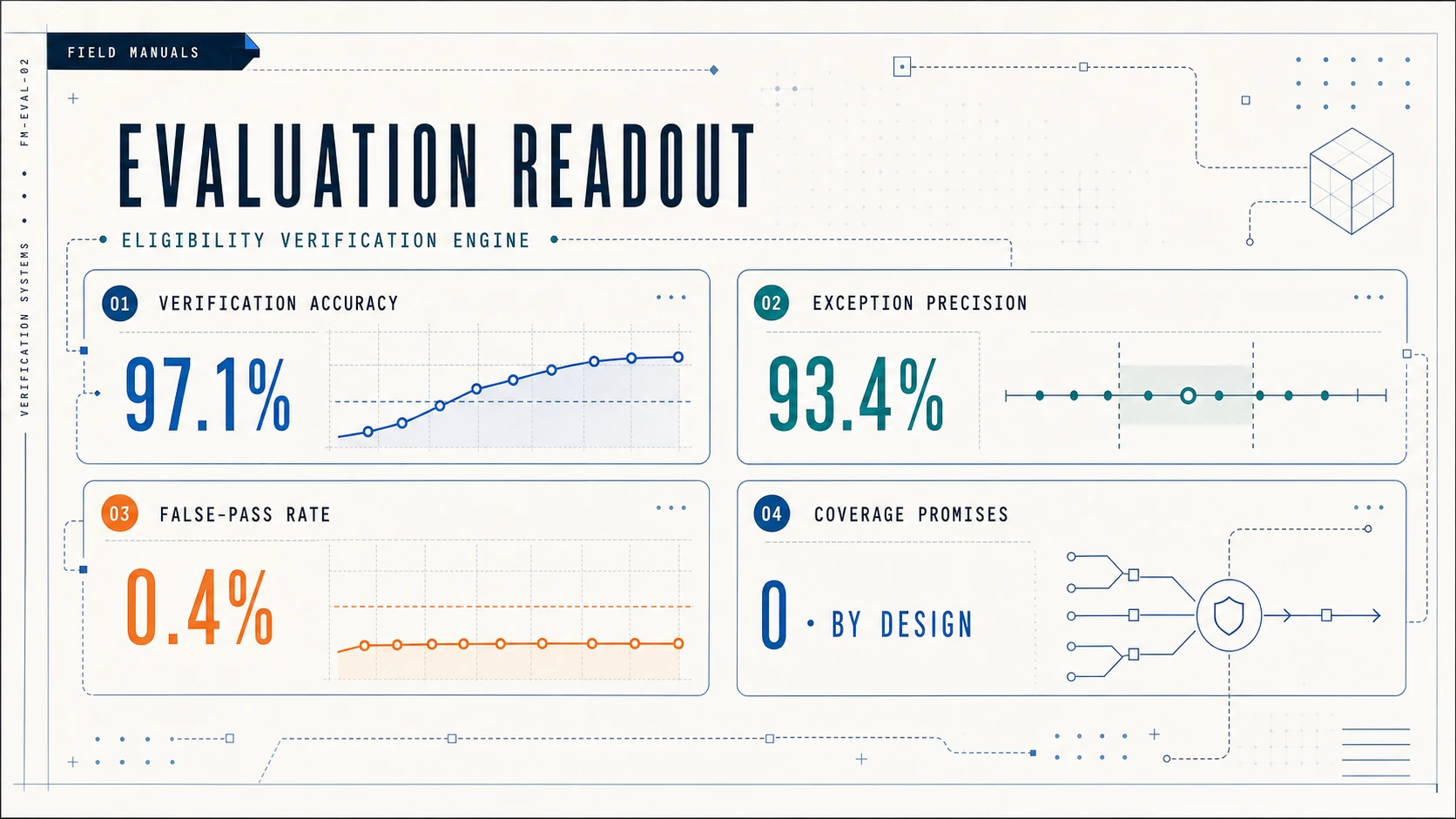
Golden set: your historical verifications · thresholds are contract acceptance criteria · illustrative values
The verification itself is machine work: pull tomorrow’s schedule, query the payer, read the response, re-check the morning of the visit. The ones that slip surface a month later on the denial report, so front offices never see their own error rate.
Eligibility looks automated. The denial report disagrees.
On paper this is solved: 96% of health plans support fully electronic eligibility checks (CAQH Index, 2024). In practice, the electronic part is the request. What comes back is a raw 271 response a human still has to read: is the plan active, what is the copay, how much deductible remains, does the plan carve out the service you are about to deliver.
CAQH prices the human handling at $8.57 per manual check against $2.00 fully electronic, and still counts eligibility as the industry’s largest remaining savings pool: $11.7 billion a year. The gap is not the transaction. It is the reading, the schedule sweep, and the exception chase, and in most practices that work goes one of three ways.
Portals and payer phone calls
Accurate when someone has time. Nobody has time on a full schedule, and a check eats 8 to 35 minutes of staff attention.
Buy verification software
pVerify publishes honest per-transaction pricing and Availity has a free portal tier. But they sell the transaction, not the interpretation. Your staff still reads every response.
Hand it to a verification team
An offshore team absorbs the grind for per-chart fees that never end, with quality you cannot inspect and PHI outside your walls.
Own the machine
An agent that sweeps the whole schedule, reads every response, and routes only the genuine exceptions to your people. Fixed scope, fixed price, eval suite included.
A verification pipeline, fixed scope, delivered in four weeks
Sweep
The agent reads your appointment schedule from your practice-management system, three days ahead and again the morning of the visit.
Verify
It runs 270/271 checks through your existing clearinghouse connection and reads the response: coverage status, copay, coinsurance, remaining deductible, service carve-outs, normalized across your top ten payers.
Flag
Terminated plans, demographic mismatches, missing referral or authorization indicators, and possible secondary coverage become exceptions, each with a reason and the payer evidence attached.
The gatehuman judgment
Exceptions route to your front office for human review before anyone talks to the patient. The agent never tells a patient they are covered, never quotes a benefit, and cannot be configured to. Enforced in code.
Scope is deliberately narrow: one practice-management system, one clearinghouse connection, your top ten payers by volume. That is what makes the price fixed and the timeline honest. Portal-only plans and phone-only edge cases route to the exception queue with whatever the agent did find, so the human call starts warm instead of cold.
The eval suite is the acceptance test
Every vendor in this market claims accuracy; the methodology never ships. My acceptance criteria are written into the contract as eval scores, and you keep the machinery that produces them.
Golden dataset
Built from your historical verifications and the denials that followed them, not synthetic examples.
Verification-accuracy regression
The agent’s coverage determinations are scored against known outcomes. The false-pass rate, a patient cleared who was not actually covered, is the number that costs you money.
Exception-routing precision
Flagging everything is as useless as flagging nothing, because a queue full of false alarms becomes a queue nobody reads. False-flag rates are measured and thresholded too.
Parallel-run gate
The agent runs alongside your current process on live schedules until it clears the thresholds. No cutover before the score clears.
You do not take my accuracy claim, or anyone’s. You re-run the suite: this quarter, next quarter, after every payer plan-year rollover. A verification agent without a measured exception gate is just a faster way to be confidently wrong.
The price is $12,000. Here is exactly what it buys.
One price. No tiers, no per-transaction meter, no quote theater. For scale: at $8.57 of staff labor per manual check (CAQH Index, 2024), this build costs roughly 1,400 checks. A front office doing twenty a day spends that in a quarter, every quarter, forever.
- Discovery workshop: your payer mix, your denial history, where the exception gate sits
- Schedule ingestion from your practice-management system (one system)
- Clearinghouse integration for 270/271 eligibility checks (one connection)
- Response-parsing agent normalized across your top ten payers
- Pre-visit batch sweep plus day-of re-verification
- Exception queue with reasons and payer evidence attached
- Guardrails in code: no patient-facing coverage statements, confidence floors, mandatory human review
- Golden dataset built from your historical verifications and downstream denials
- Eval harness: verification-accuracy regression and exception-routing precision
- Parallel run, handover pack, runbook, and your team trained to run the suite
Against the alternatives
| This build | Eligibility SaaS | Enterprise platform | Outsourced team | |
|---|---|---|---|---|
| Price | $12,000, once, public | $125–$395/month plus per-transaction fees, forever | Undisclosed; health-system procurement | Per chart, forever |
| What you get | Checks run and read, exceptions routed | Raw 271 responses your staff reads | Suite integration, long deployment | People doing the grind offsite |
| Who owns it | You: code, evals, golden set | The vendor | The vendor | Nobody; it’s labor |
| Proof it works | Eval suite you re-run yourself | Uptime, not accuracy | Their deck | Spot checks |
| Exception handling | Human gate, precision measured | Your staff, unmeasured | Configurable, opaque | Their staff, invisible |
An RCM firm can read that table across its whole client list: one owned build, deployed per practice, instead of a per-transaction meter running in every office.
How the four weeks run
- Week 1
Discovery and golden set
Map the payer mix and verification workflow, pull historical verifications and the denials that followed, fix the acceptance thresholds in writing.
- Week 2
Pipeline
Schedule ingestion, clearinghouse integration, response parsing across the top ten payers.
- Week 3
Gate and guardrails
Exception queue with evidence attached, routing rules, the no-patient-facing-statements constraint, confidence floors.
- Week 4
Parallel run
The agent sweeps live schedules alongside your current process. We compare against the golden set and your staff’s live judgments. Cutover only when thresholds clear.
- Days 1–30 after
Stabilization
I watch the evals, fix drift, tune the exception thresholds. Then you own it outright.
Straight answers
The questions every practice administrator and RCM lead asks before booking the call.
Does the agent tell patients whether they're covered?
No, and it cannot be configured to. Coverage conversations stay with your staff. The agent verifies, flags, and attaches evidence; a human makes every call that reaches a patient. That constraint lives in code, and it is why this project survives compliance review.
What exactly does the $12,000 include?
Discovery, schedule ingestion, clearinghouse integration, the parsing agent, the exception queue, guardrails, golden dataset, eval harness, parallel run, handover, and 30 days of stabilization. The only costs outside the number are your own API, hosting, and clearinghouse fees, plus the optional monitoring retainer.
Which practice-management systems and clearinghouses do you support?
One of each per build; that is what keeps the price fixed. If your system exports a schedule and your clearinghouse offers standard 270/271 access, you likely fit. We confirm both on the call, and if they don't fit, you'll have lost 30 minutes, not a deposit.
What about payers that require portal logins or phone calls?
They become exceptions by design. The agent packages whatever it could confirm electronically, so your staff starts the portal session or phone call with the gap already named. The top-ten-payer scope typically covers the large majority of a practice's volume; the tail stays human.
Is this HIPAA compliant?
The architecture is BAA-ready: PHI-handling guardrails in code, minimum-necessary retrieval, and the option to run on infrastructure you control. Compliance obligations and the BAA itself are scoped in discovery and stated plainly, not hand-waved.
What are the ongoing costs?
Your own LLM API and hosting, plus clearinghouse per-transaction fees, typically $150–$500/month combined at practice volume, all on your accounts. The optional $750/month monitoring retainer is exactly that: optional, and cancelable anytime.
Why is the price public when every competitor quotes custom?
Because scoped work can be priced, and unscoped work shouldn't be sold. One system, one clearinghouse, ten payers is a real scope, so $12,000 is a real price. If discovery reveals your situation needs more, you get a new scope with a number on it before any work starts.
Know before they arrive.
Eligibility is the rare problem where the fix is boring and the payoff is immediate: fewer surprises at the desk, fewer denials with a 30-day fuse, and a front office that works exceptions instead of phone queues. The checking is machine work. The judgment stays with your people.
30 minutes · the price stays $12,000 · if it’s not a fit, I’ll say so