An AI denial appeals agent your clinicians sign.
Appeals win four times out of five, and almost nobody files them. I build the machine that removes the drafting hour. The judgment stays with your clinician.
30 minutes. The price on this page is the price on the call.
“Per LCD L34220 §2.1, MRI is indicated when conservative therapy has failed…”
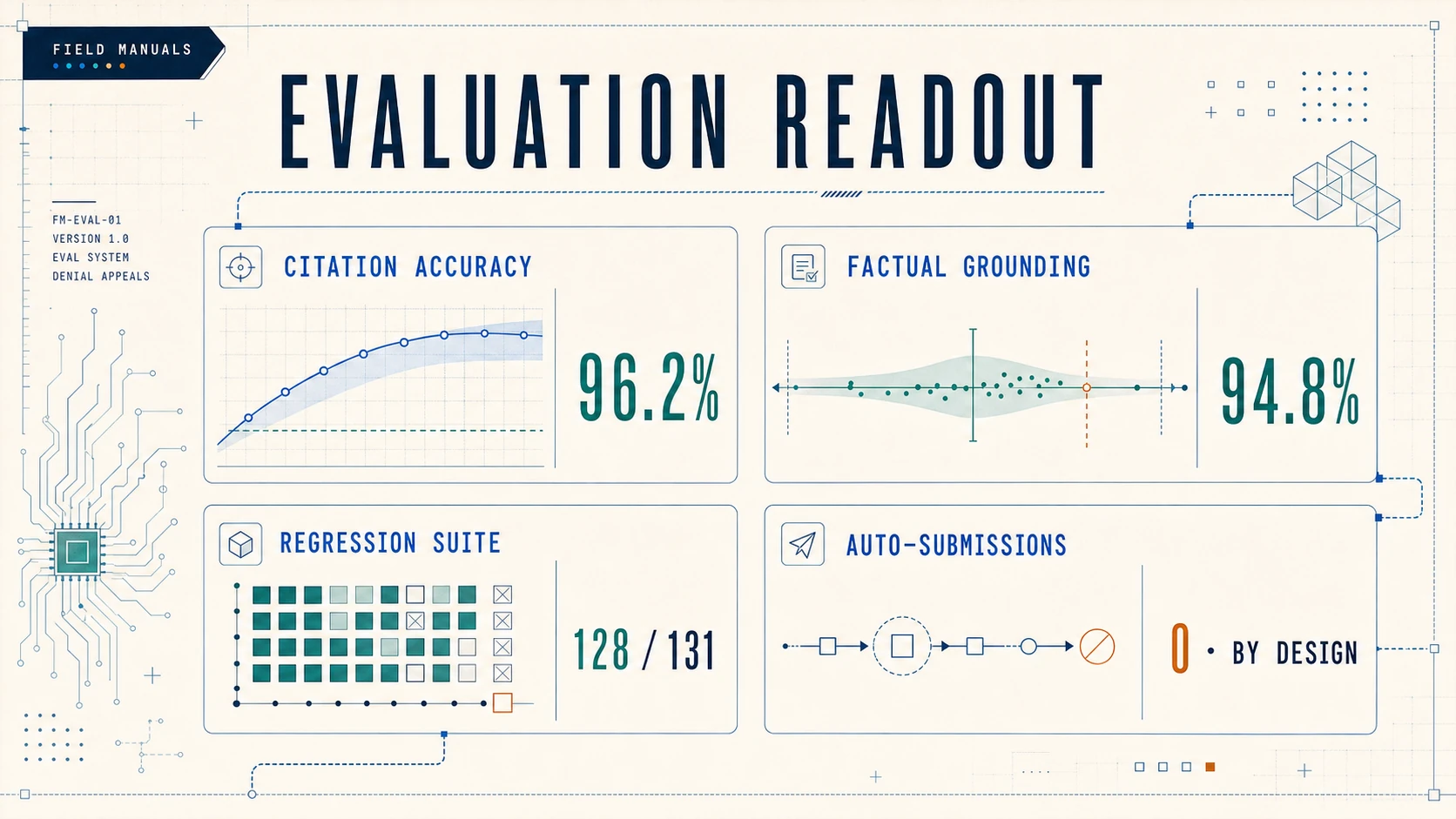
Golden set: your historical denials · thresholds are contract acceptance criteria · illustrative values
Read that from the revenue side: the overwhelming majority of appealed denials succeed, and the overwhelming majority of denials are never appealed. The money is not in fighting harder. It is in appealing at all.
The denial backlog is a profit center you’re not running
The industry spends $25.7 billion a year on denial rework, at roughly $57 of administrative cost per denied claim. Initial denial rates average 11.65% and pass 20% in specialty settings. Every RCM firm and specialty practice knows this. The response is always one of three things:
Write appeals manually
Works, wins often, doesn’t scale. The person who writes good medical-necessity arguments has a full-time job already.
Rent an enterprise platform
Waystar, AKASA, Innovaccer: capable systems, with hospital-system contracts and hospital-system sales cycles. None of them publishes a price.
Hand it to an appeals service
Staffed expertise, fast turnaround, and a cut of every recovery, forever.
Own a scoped appeals agent
It drafts every letter and submits none of them. Fixed scope, fixed price, eval suite included.
A denial-appeals pipeline, fixed scope, delivered in six weeks
Intake
Document processing reads your denial letters and EOBs (payer, denial code, service, dates) with no manual re-keying.
Retrieval
A RAG pipeline over the payer’s own policy documents and the patient’s chart context finds the medical-necessity criteria the denial ignored.
Draft
The agent writes the appeal letter, citing the payer’s policy language and the clinical evidence, in your letterhead format.
The gatehuman judgment
A clinician reviews and signs every letter before it goes anywhere. Enforced in code, not in a policy document. The system cannot submit. That constraint is permanent and non-configurable.
Scope is deliberately narrow: one specialty, your top five denial reasons, one EHR export format. That is what makes the price fixed and the timeline honest. Expansion is a follow-on, priced the same way, in the open.
The eval suite is the product
Every vendor in this market claims accuracy. None of them shows you the harness. My acceptance criteria are written into the contract as eval scores, and you keep the machinery that produces them.
A golden dataset
Built from your historical denials and their outcomes, not synthetic examples.
Citation-accuracy tests
Every policy citation in a drafted letter is checked against the actual payer document. Letters that cite policies that don’t say what the letter claims fail the suite.
Factual-grounding regression
Drafted clinical statements are verified against the chart context they came from.
A parallel-run gate
The agent runs alongside your current process until it clears the thresholds on live denials. No cutover before the score clears.
When I hand over, you own the eval harness, the golden dataset, the regression suite, and a runbook. You don’t have to trust my accuracy claim. You can re-run it: this quarter, next quarter, after every model update. An appeals agent without a measurable judgment gate is a liability with a nice demo.
The price is $28,000. Here is exactly what it buys.
One price. No tiers, no “starting at,” no quote theater.
- Discovery workshop: your denial taxonomy, your top five denial reasons, where the clinician gate sits
- Denial-letter and EOB intake pipeline (IDP)
- Payer-policy RAG pipeline for one specialty
- Appeal-letter drafting agent with policy citations
- Clinician review-and-sign workflow (the enforced gate)
- Golden dataset built from your historical denials and appeal outcomes
- Eval harness: citation accuracy, factual grounding, regression suite
- Guardrails in code: no auto-submission, PHI-handling constraints, confidence-floor escalation
- Parallel-run period against your current process, with published thresholds
- Handover pack: runbook, eval documentation, your team trained to run the suite
Against the alternatives
| This build | Enterprise platform | Appeals service | Freelancer | |
|---|---|---|---|---|
| Price | $28,000, once, public | Undisclosed; six-figure annual territory | Contingency on every recovery, forever | Hourly, open-ended |
| Timeline | 6 weeks + 30-day stabilization | Months of procurement first | Fast, but never yours | Unknown |
| Who owns it | You: code, evals, golden set | The vendor | The vendor | You, minus the proof |
| Proof it works | Eval suite you can re-run | Their accuracy claim | Their track record | None shipped |
| Clinician control | Gate enforced in code | Varies by configuration | Outside your walls | Whatever got built |
A practice losing $150K a year to unworked denials recovers the build cost in the first quarter it starts appealing at volume. I won’t promise your overturn rate; that’s what the parallel run measures. I will show you the score before you cut over.
How the six weeks run
- Week 1
Discovery
Map the denial workflow, pull historical denials and outcomes, define the top-five reasons in scope, and fix the acceptance thresholds in writing.
- Weeks 2–3
Golden dataset + pipeline
Label your historical denials and appeal outcomes; stand up intake and the payer-policy RAG.
- Weeks 4–5
Drafting agent + gate
Letter generation with citations, the clinician sign-off workflow, guardrails in code.
- Week 6
Parallel run
The agent drafts alongside your current process. We compare against the golden set and live clinician judgments. Cutover only when thresholds clear.
- Days 1–30 after
Stabilization
I watch the evals, fix drift, tune escalation. Then you own it outright.
Straight answers
The questions every RCM lead and practice administrator asks before booking the call.
Does the AI submit appeals automatically?
No, and it can't be configured to. Every letter requires clinician sign-off, and the constraint lives in code. Denial-automation liability is the top reason healthcare AI projects die in legal review; this design is how the project survives it.
What exactly does the $28,000 include?
Discovery, intake, RAG, drafting agent, clinician gate, golden dataset, eval harness, parallel run, handover, and 30 days of stabilization. The only costs outside the number are your own API/hosting spend and the optional monitoring retainer.
How do you prove it works on our denials, not just in a demo?
The golden dataset is built from your historical denials and outcomes, and the contract's acceptance criteria are eval thresholds on that set. Then a parallel run tests it against live denials before anything cuts over. You are never asked to take an accuracy claim on faith.
Which specialties and EHRs do you support?
The build covers one specialty and one EHR export format; that's what keeps the price fixed. On the call we check whether your denial mix and export path fit. If they don't, I'll tell you, and you'll have lost 30 minutes, not a deposit.
Is this HIPAA compliant?
The architecture is BAA-ready: PHI-handling guardrails in code, minimum-necessary retrieval, and the option to run on infrastructure you control. Compliance obligations and the BAA itself are scoped in discovery and stated plainly, not hand-waved.
What happens after handover?
You own the code, the golden dataset, and the regression suite, plus a runbook your team is trained on. Models drift and payers rewrite policies, so re-run the suite on a schedule: yourselves, or through the $1,500/month monitoring retainer, which you can cancel anytime.
Why is the price public when every competitor quotes custom?
Because scoped work can be priced, and unscoped work shouldn't be sold. The scope on this page is genuinely fixed, so the price can be too. If discovery reveals your situation needs more, you'll get a new scope with a number on it before any work starts.
What revenue-cycle teams say
“His vast knowledge of technologies and a natural problem-solving mindset consistently lead us through complex challenges with clarity and confidence.”
Appeals win. File them.
The overturn statistics haven’t changed for years: most denials that get challenged, fall. The bottleneck is drafting capacity, and drafting is exactly the work a machine should do while your clinician holds the pen that matters.
30 minutes · the price stays $28,000 · if it’s not a fit, I’ll say so