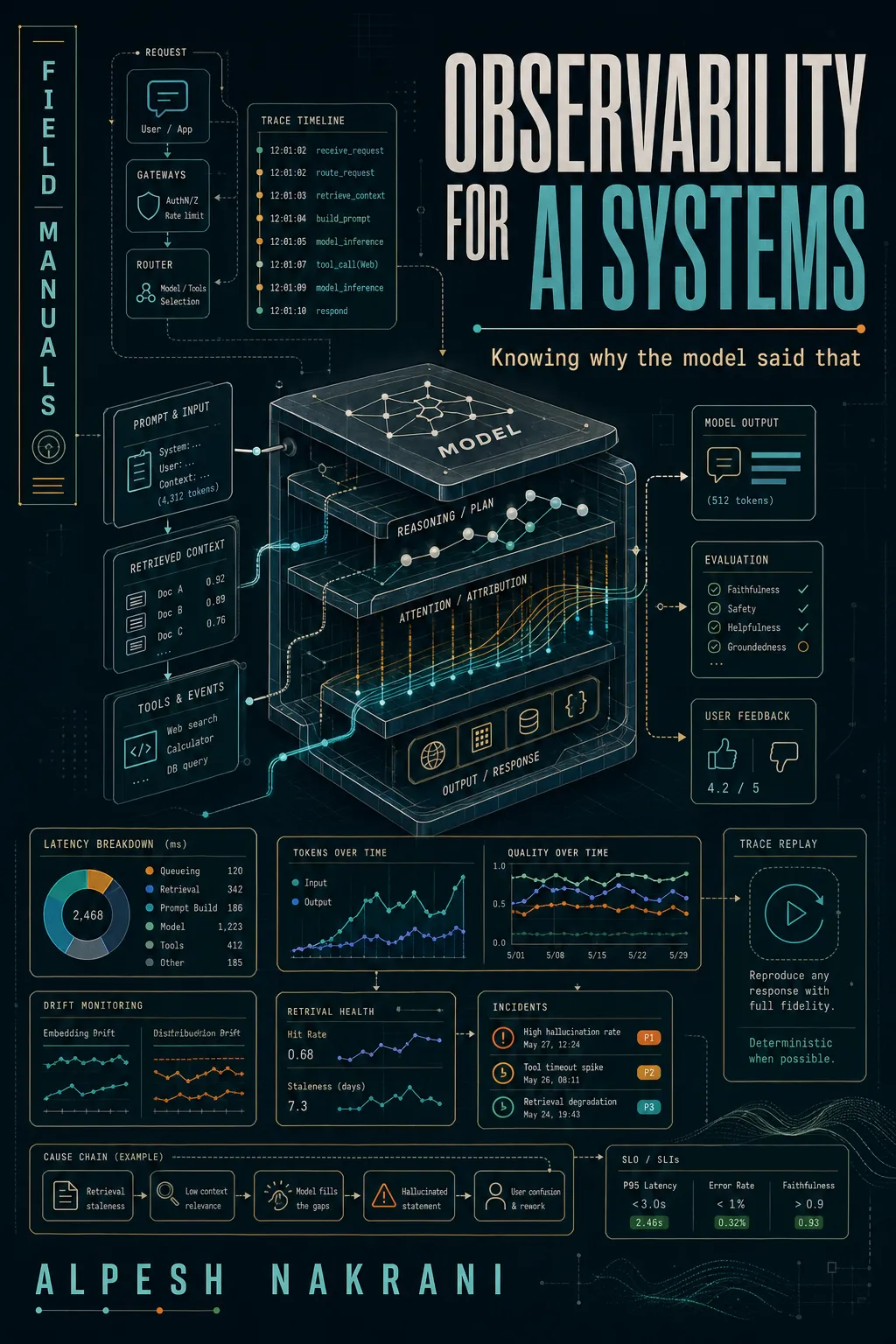
Observability for AI Systems
Knowing why the model said that
A book by Alpesh Nakrani
Subscribe to get the complete book. Your PDF downloads immediately.
- Pages
- 90
- Chapters
- 11
- Format
- PDF · 20.7 MB
What's in the book
Traditional observability assumes determinism. AI systems are probabilistic, so the question shifts from where it broke to why it drifted. This manual builds the tracing, prompt logging, and replay you need to debug a system whose behavior changes with every model version.
A stack trace tells you where code broke. What tells you why a model drifted? Tracing, logging, and replay for probabilistic systems.
Table of contents
PDF page- INTIntroduction: The Log Said It Happened. It Never Said Why.9
- 01What Observability Means When the Same Input Can Answer Differently Twice15
- 02The Trace Record: What You Capture at the Moment of Decision21
- 03Replay: Rerunning a Request Exactly as It Happened27
- 04Four Kinds of Wrong: Code Defect, Data Defect, Model Drift, Policy Gap33
- 05Release Markers: Correlating a Behavior Change to a Deploy39
- 06Drift Detection: Watching Behavior Change Over Weeks, Not Requests45
- 07Cost and Latency Are Part of the Same Observability System51
- 08Alerting on the Right Signals, Not Just Uptime57
- 09Incident Response: Root-Causing an AI-Specific Outage63
- 10Privacy and Redaction: What You're Allowed to Log69
- 11Make Every Important Answer Replayable Before Launch75
- ENDConclusion: Observability Is a Promise You Make Before the Incident81
The full chapters, illustrations, and reference material are included in the downloadable PDF.
Observability for AI Systems
The complete edition,
ready to read offline.
Get your free copy.
Subscribe to Alpesh’s book and writing updates. Unsubscribe anytime.
Your download is ready.
You’re subscribed. Your PDF download should start automatically.
Download PDF againIf it doesn’t start, use the button above.