AI in Revenue Operations: The Human/Machine Split, Mapped
A stage-by-stage visual of AI in revenue operations: where the machine already does the whole job, where the human still owns the decision, and where review becomes the real constraint.

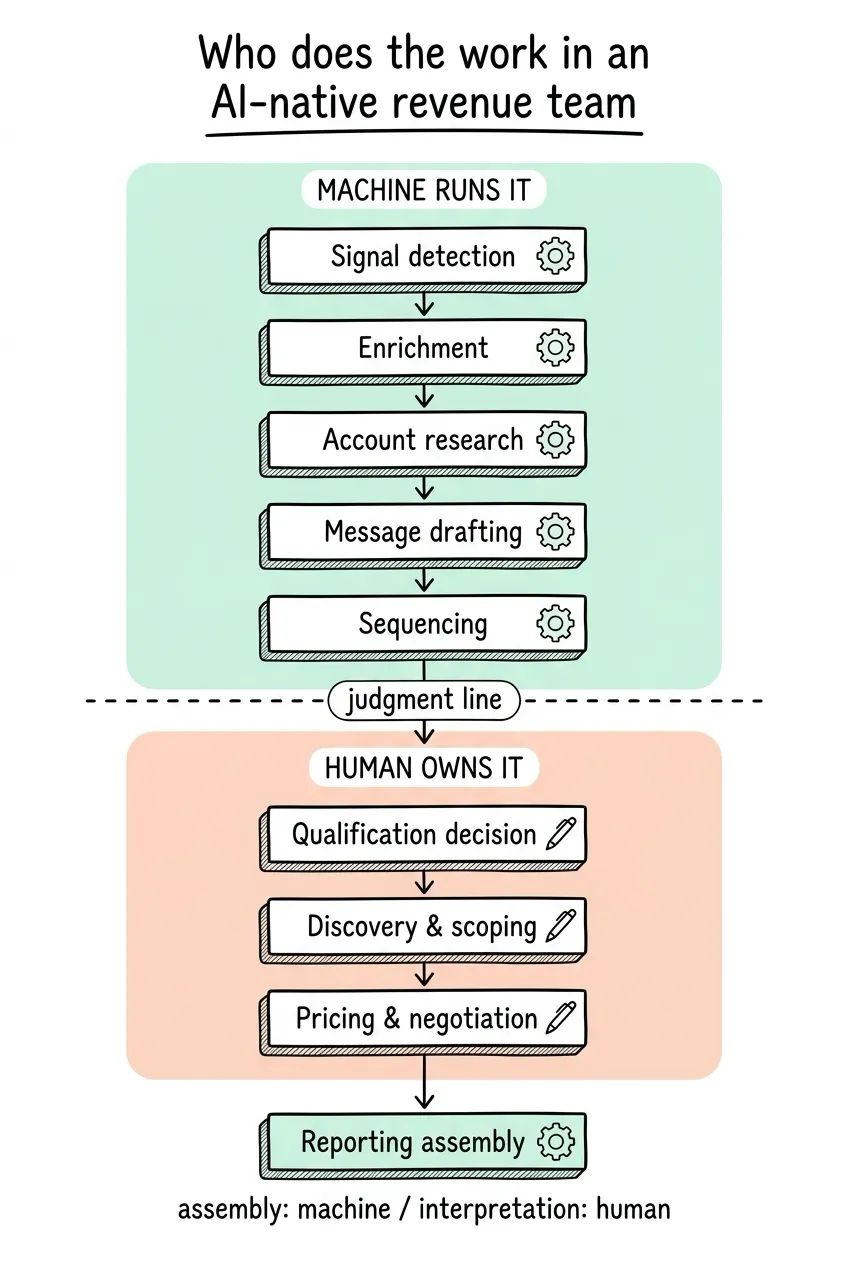
AI in revenue operations now does most of the work at the top of the funnel and very little of the work at the bottom. Signal detection, enrichment, research, drafting, routing, and reporting are mostly machine work. Qualification decisions, discovery, scoping, pricing, and negotiation are mostly human. The interesting part is the middle, where machine output is abundant and human review capacity is the bottleneck.
I've described this as five layers in the AI-native growth team operating model. This piece draws it, stage by stage, so you can compare your own team's split against it.
Key takeaways
- Machine share falls steeply as you move from detecting to deciding. Roughly 90% or more at signal and research, 10% to 20% at judgment and close, by my working estimates.
- The review layer sets your real capacity. If machines produce 500 briefs a week and a person can judge 50, pipeline is capped at 50.
- Buyers have made the same split. They use AI to research and shortlist, then want a human to validate.
- The costliest errors sit where machine share is lowest. That's not a coincidence. It's why those stages stayed human.
- Use the map to find misallocated human time. Senior people doing machine-share work is the most common waste.
The full map: machine share by revenue stage
The bars below are my working estimates of how much of each stage's work is done by machines in a mature AI-native motion. They're opinions from operating, not an industry benchmark.
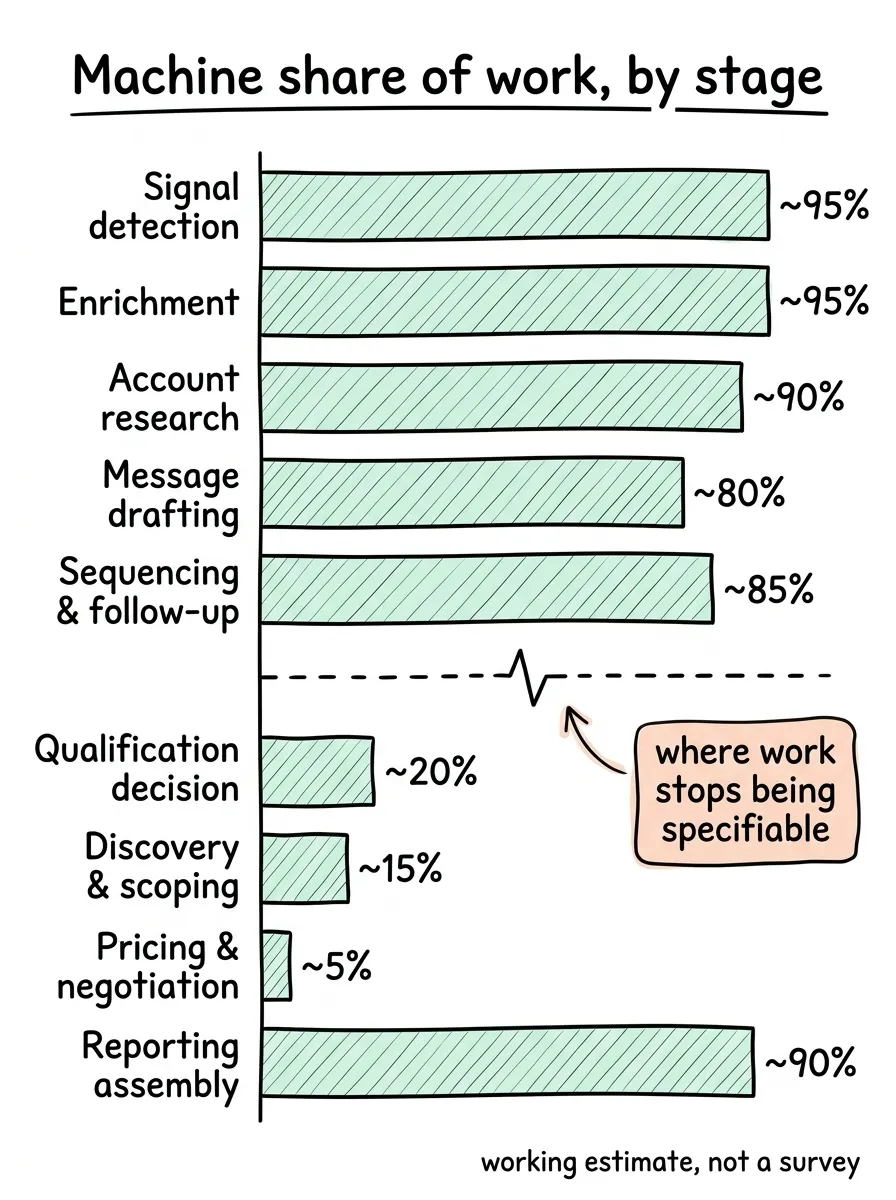
Source: author's operating estimates for a signal-led B2B services motion. Not a survey.
Two things stand out. First, the cliff between sequencing and qualification. That's where the work stops being specifiable. Second, reporting jumps back up at the end, because assembling numbers is specifiable even though interpreting them isn't.
Stage by stage: what the machine runs, what the human keeps
Signal and enrichment
Machine: watches thousands of accounts daily for hiring spikes, leadership changes, funding, stack changes, and deadlines. Keeps firmographic and contact data fresh.
Human: decides which signal types count and retires the ones that don't produce conversations. The playbook is in the signal-based selling pillar.
Research
Machine: builds the account brief and buying-group map, with sources.
Human: grades a weekly sample and fixes systematic errors. See how to build an AI account research agent.
Drafting and sequencing
Machine: first-draft messages, channel order, timing, stop rules.
Human: owns the voice, the allowed claims, and the senior-track rewrites.
Qualification
Machine: flags fit, scores signals, summarizes replies.
Human: decides whether a reply is a buyer or a researcher, whether a forcing function is real, and whether the account deserves a senior person. This is where most of the value lives.
Discovery, scoping, and close
Machine: prep packs, call summaries, proposal first drafts.
Human: the conversation, the scope, the price, the negotiation, the relationship.
The review bottleneck, visualized
The constraint in an AI-native revenue team isn't production. It's how much machine output humans can judge well. Here's an illustrative week for a three-seller team:
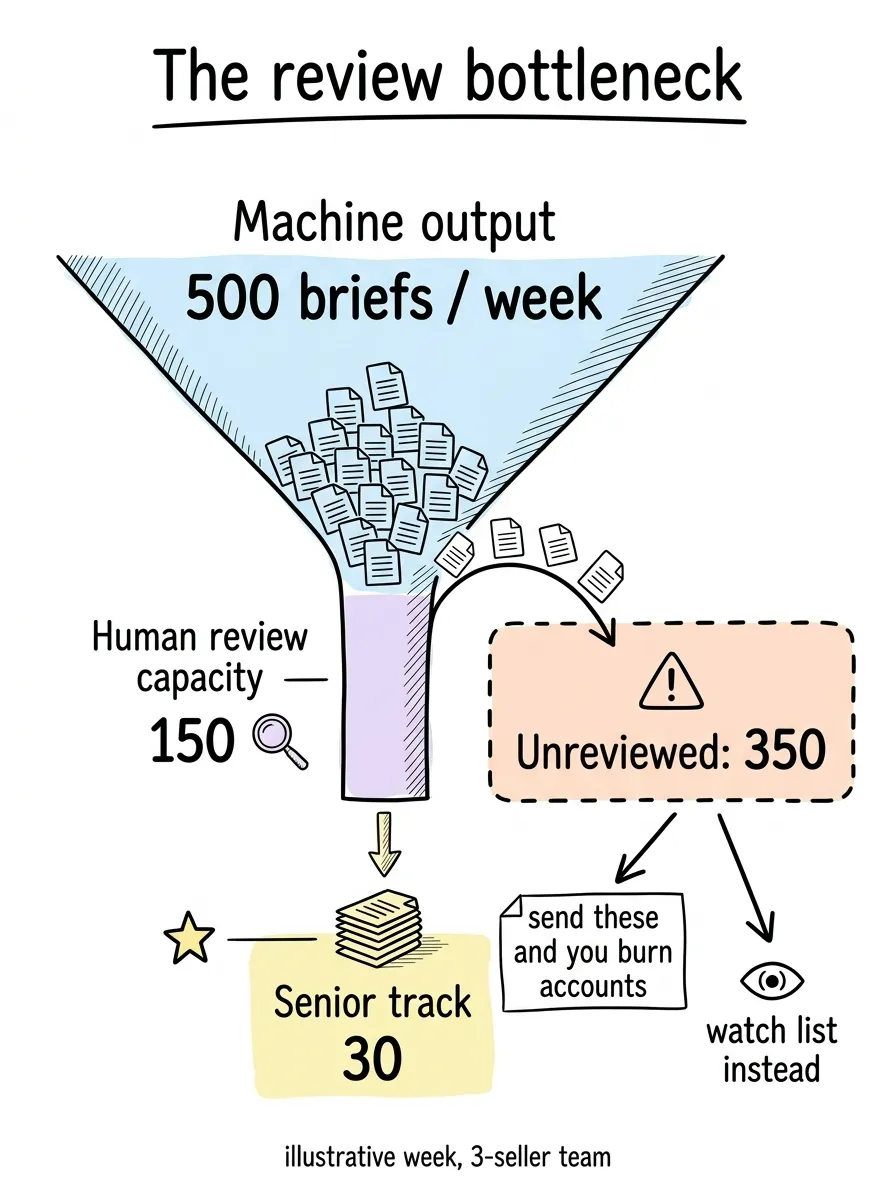
Illustrative numbers to show the shape of the constraint, not a measured result.
If you push all 500 into outreach, 350 accounts receive messages nobody checked. Some will be wrong. All will spend a slot in that buyer's attention. The case against doing that is in volume outbound is a tax on your future TAM.
The better design routes the unreviewed 350 to a watch list until a second signal appears, and spends human review on the 150 with the best signals.
The buyer side of AI in revenue operations
Buyers have made almost the same split, which is why this map holds.
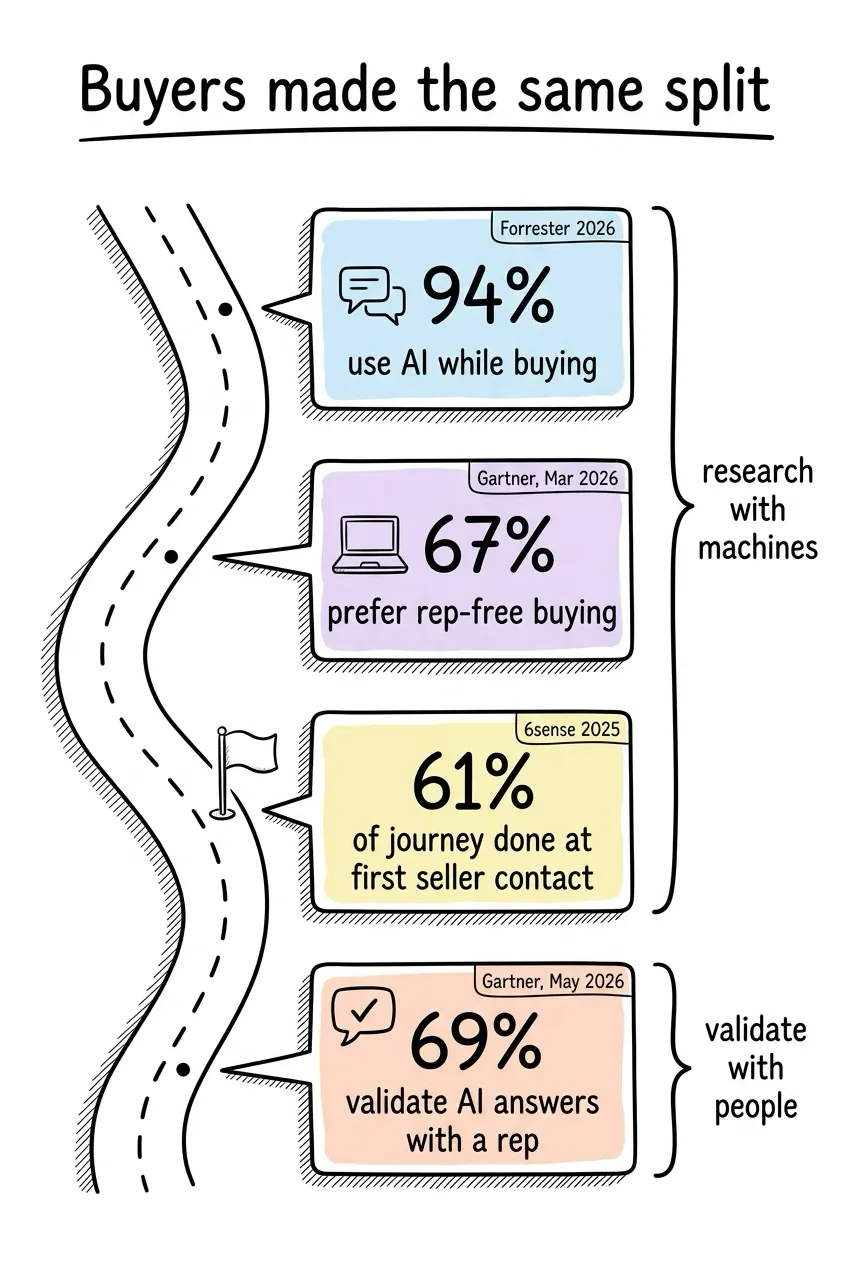
Sources: Forrester State of Business Buying 2026; Gartner press releases 2026-03-09 and 2026-05-20; 6sense 2025 Buyer Experience Report.
Buyers research with machines and validate with people. Forrester reports 94% of buyers use AI in the process. Gartner found 67% prefer a rep-free experience, yet 69% turn to reps to validate what AI told them. Those findings aren't contradictory. They describe the same split I've drawn above, seen from the other side of the table. 6sense adds the timing: first seller contact arrives about 61% of the way through the journey.
The implication for revenue operations: your machine layer has to show up in the buyer's research phase, through public evidence and content AI assistants can cite. Your human layer has to be excellent at validation, which means sellers who can answer hard questions, not recite a deck. More on the research phase in how buyers use AI to build vendor shortlists.
How to map your own team
Run this exercise with your revenue leadership in an hour:
- List your stages. Use the nine above or your own.
- Estimate current machine share for each. Be honest. Most AI-assisted teams are at 20% to 40% on research and drafting.
- Estimate target machine share. Use the map as a reference, not a rule.
- Find the gaps where senior people do machine-share work. That's your first reallocation.
- Estimate review capacity. How many briefs, drafts, or replies can your team judge well each week? That number caps throughput.
A composite: when Farah, a CRO at a cloud services firm, ran this exercise, her team estimated research at 30% machine share and qualification at 60%. The second number was the alarming one. The team had automated the qualification decision through lead scoring, and senior sellers were accepting scores without reading replies. Proposal rates had been falling for two quarters. Moving qualification back to a human decision, and moving research toward the machine, was the fix.
The trade-off
A clean split makes the team faster and more focused. It also concentrates risk at the review layer. If the people judging machine output are overloaded or undertrained, errors pass through at scale. Invest in the reviewers: clear specs, small samples, and time protected on their calendars. The argument that judgment is the scarce input is in The Judgment Economy, and the specific tasks I delegate are listed in 12 growth tasks I delegate to machines.
If you want to compare your team's map against this one, send it to me on LinkedIn.
Frequently asked questions
How is AI used in revenue operations?
AI in revenue operations handles signal detection, data enrichment, account research, message drafting, sequencing, call summaries, CRM updates, pipeline anomaly detection, and report assembly. Humans keep qualification decisions, discovery, scoping, pricing, and negotiation.
What revenue tasks should stay human?
Tasks where good output can't be specified in advance and errors are costly: deciding whether a reply is a real buyer, judging forcing functions, choosing which accounts get senior attention, scoping, pricing, and negotiating.
What limits an AI-native revenue team's capacity?
Human review capacity. Machines can produce far more briefs, drafts, and summaries than people can evaluate. Throughput is capped by how much output the team can judge well, so reviewers need clear specs and protected time.
Do buyers still want to talk to salespeople?
Many prefer to research on their own, but most still want a human to validate. Gartner found 67% of B2B buyers prefer a rep-free experience and 69% turn to reps to validate AI-generated insights. The seller's role shifts from informing to validating.