The B2B Sales Funnel Stages I Actually Run, Drawn
Most funnels are drawn around what marketing and sales do. This one is drawn around what the buyer has demonstrated. Five stages, each with an exit test you can audit.

The B2B sales funnel stages I run are signal, conversation, qualified opportunity, proposal, and revenue. Each stage is defined by something the buyer has demonstrated, not by something the seller did. An account moves forward only when it passes a written exit test, which makes the funnel auditable and keeps sales and marketing from counting the same thing differently.
Traditional funnels like awareness, interest, consideration, intent, evaluation, and purchase describe a buyer's mindset, which you can't observe. Or they describe seller activity, like MQL, SAL, SQL, which drifts with every definition change. I wanted stages that a skeptical CFO could audit against evidence. Here's the funnel, drawn.
Key takeaways
- Every stage is defined by buyer evidence. A signal fired, a problem was discussed, a buyer was engaged, a scope was accepted for review, a contract was signed.
- Each stage has one written exit test. If you can't audit it, it isn't a stage.
- The biggest drop is signal to conversation. That's where account selection and judgment matter most.
- Conversion should be measured by cohort. Snapshot views hide deterioration.
- One funnel for marketing and sales. Two funnels with two definitions guarantee conflict.
The five stages at a glance
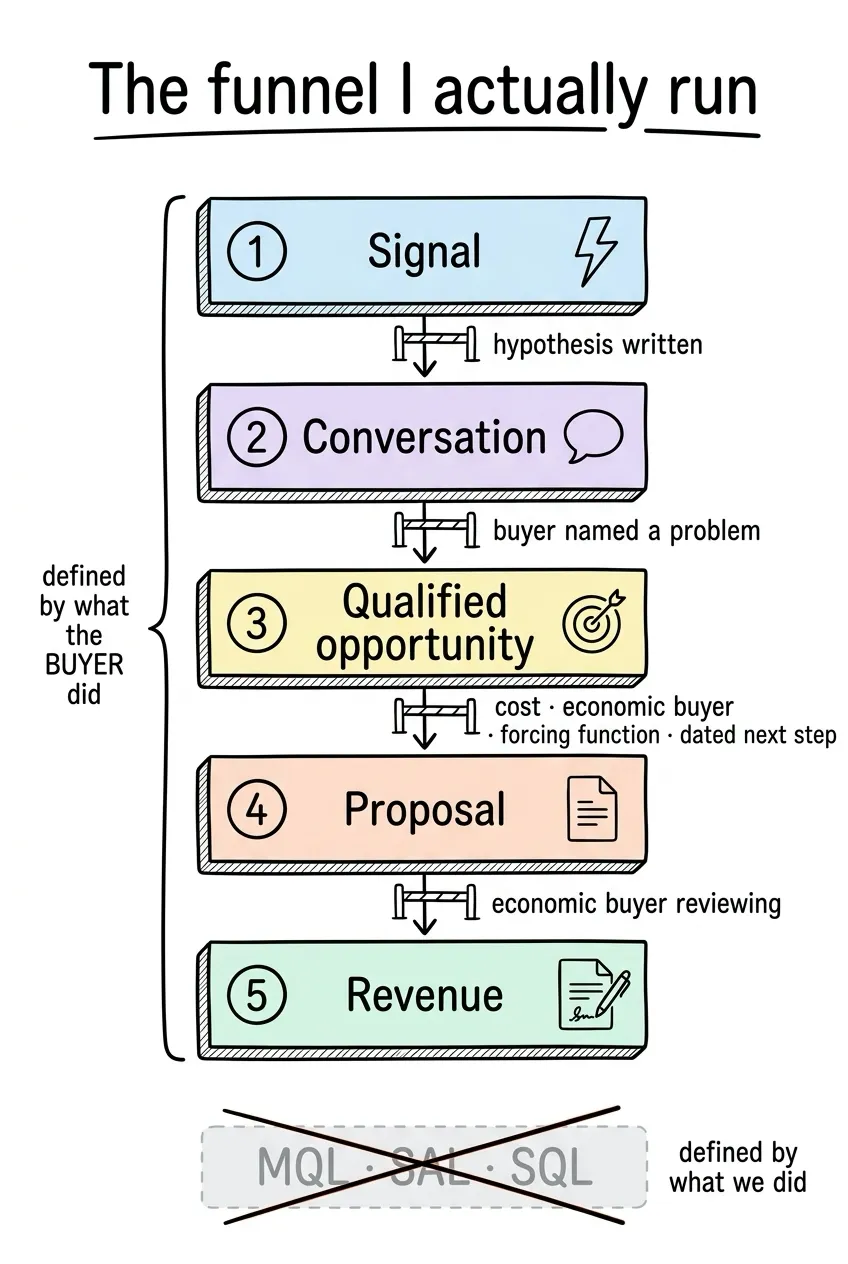
Stage definitions used in the author's growth motion. Exit tests below.
Stage by stage: exit tests, owners, and metrics
| Stage | Exit test to advance | Primary owner | Metric it feeds |
|---|---|---|---|
| Signal | Hypothesis written; account routed to a track | Machine + GTM engineer | Accounts touched by signal type |
| Conversation | Buyer discussed a specific problem on a call | Seller | Conversations per 100 accounts touched |
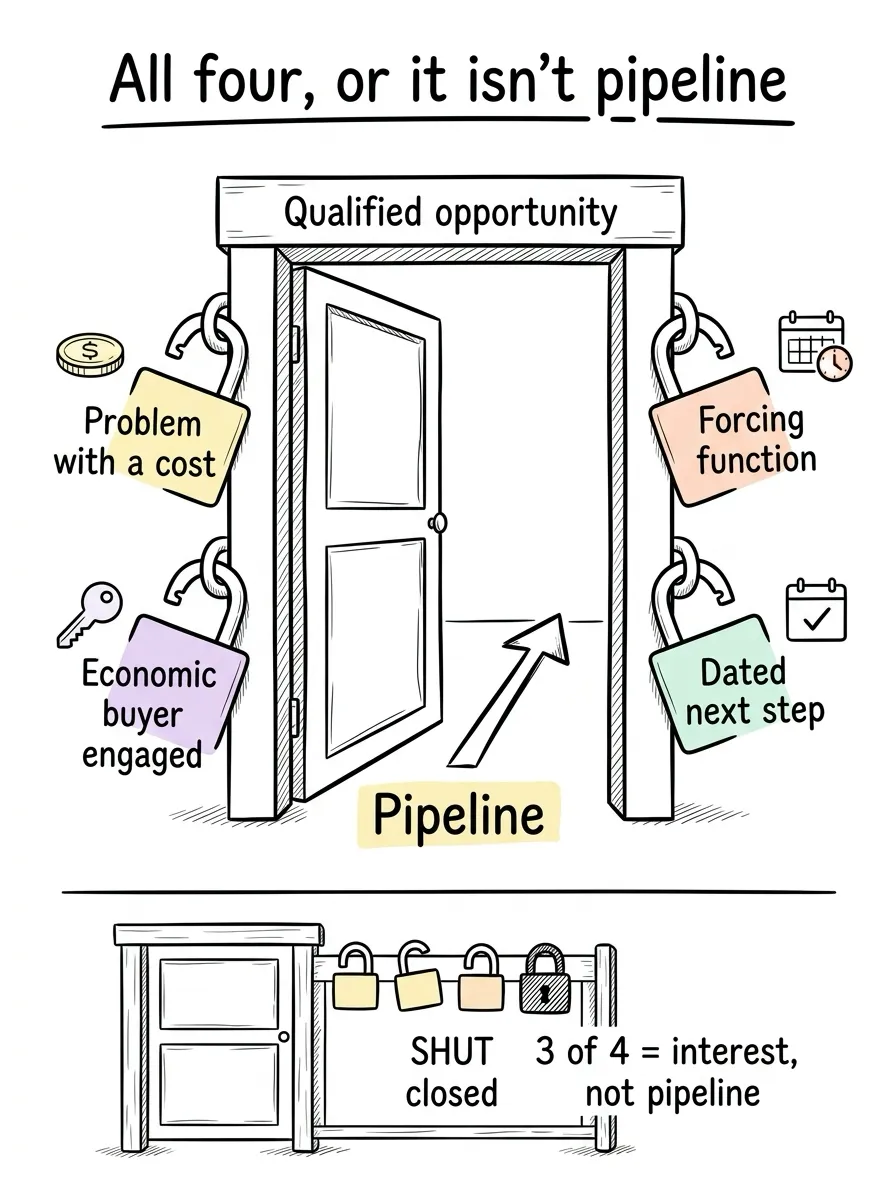
| Qualified opportunity | All four: problem with cost, economic buyer engaged, forcing function, dated next step | Seller + sales lead | Qualified opportunities by cohort |
| Proposal | Scoped proposal delivered to economic buyer, review date agreed | Senior seller | Proposal-to-close rate |
| Revenue | Contract signed, kickoff scheduled | Senior seller + delivery | Bookings, CAC payback, NRR |
The qualified-opportunity test is the one most funnels skip, and it's where most forecast error comes from. The four-part reasoning is in we had leads, not a pipeline.
Stage 1: Signal
The account showed a verifiable reason to act, such as a hiring spike, new leadership, a stack change, or a deadline. The machine detects it and drafts a hypothesis; a person decides the track. See the signal-based selling playbook.
Stage 2: Conversation
A buyer got on a call and talked about a specific problem. Not a reply, not a booked meeting that no-showed, not a demo request from a student. This is the first stage where buying intent is visible.
Stage 3: Qualified opportunity
All four conditions true at once. Three out of four is a promising conversation, not pipeline.
Stage 4: Proposal
A scope and price are with the person who can say yes, with a date to discuss. Sending a proposal to a champion who will "share it internally" doesn't count.
Stage 5: Revenue
Signed, and delivery has a start date. For services firms, I don't count revenue that hasn't been handed to delivery, because handoff is where many deals quietly unravel. See what makes a good deal from sales to delivery.
What conversion looks like across the stages
Using our signal-led LinkedIn run as the example: 650 accounts touched, 8 conversations, 4 proposals. Here's that shape drawn across the first stages:
ViitorCloud field evidence from a signal-led LinkedIn motion. Replies shown for reference; it is not a funnel stage.
Note that "replies" appears in the chart but not in the funnel. A reply is an activity signal, not buyer evidence of a problem. The reasoning is in what a good cold email reply rate measures. The full breakdown is in the LinkedIn outreach funnel infographic.
Why I don't use MQL and SQL stages
MQL and SQL are useful internal handoff labels in some organizations. As funnel stages, they have two problems.
They're defined by seller judgment, not buyer evidence. An MQL is whatever marketing's scoring model says it is. When the model changes, history becomes incomparable.
They're easy to inflate. Loosen the scoring threshold and MQLs rise without any change in buyer behavior. I described this in bad MQLs: more marketing, worse results.
Replacing them with evidence-based stages doesn't remove marketing's role. It changes what marketing is measured on: contribution to conversations and qualified opportunities, not lead volume.
Measure stages by cohort, not snapshot
A snapshot asks: how many deals are in each stage today? A cohort asks: of the conversations that happened in March, how many became qualified opportunities within 30, 60, and 90 days?
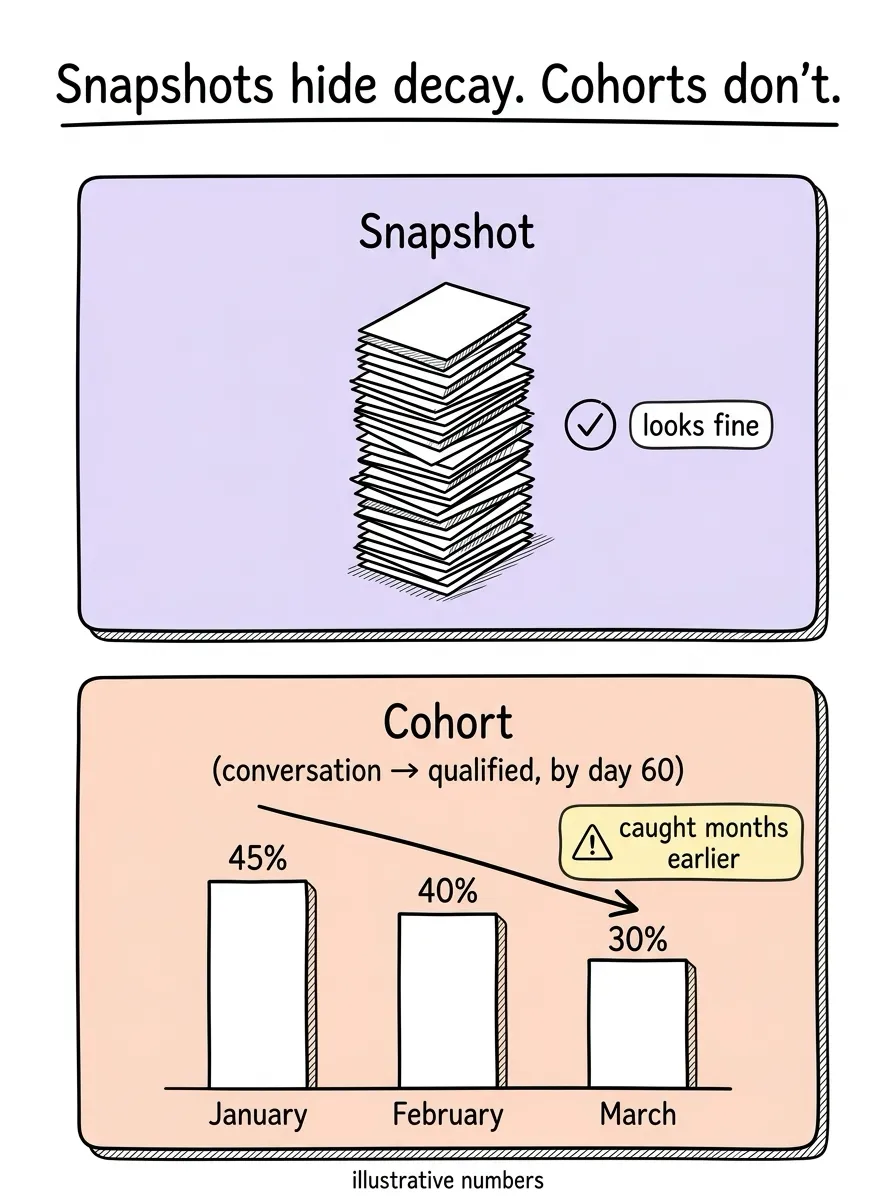
Illustrative numbers. A falling cohort rate is an early warning a snapshot can hide.
In a snapshot, a growing number of open opportunities can hide that each new cohort is converting worse. The cohort view catches it months earlier. This is one of the metrics in the B2B revenue metrics that predict bookings.
Who owns each B2B sales funnel stage
Ownership follows the AI-native growth team operating model: machines own detection and preparation, humans own the decisions that move an account forward.
- Signal: machine detects; GTM engineer maintains; growth lead decides which signals count.
- Conversation: seller holds it; machine prepares and summarizes.
- Qualified opportunity: seller proposes; sales lead verifies the four-part test.
- Proposal: senior seller scopes and prices; delivery reviews feasibility.
- Revenue: senior seller closes; delivery accepts the handoff.
A composite example
Rohan, a RevOps lead at a 120-person cloud services company, inherited a funnel with nine stages, three of which meant different things to marketing and sales. He collapsed it to these five, wrote one exit test for each, and restated twelve months of history. The restated funnel showed that the company's "pipeline" was roughly twice its qualified pipeline, and that the conversation-to-qualified rate had been falling for three quarters. Nobody had seen it, because the old stages were busy counting activity.
How to implement these stages
- Write the five exit tests on one page. Get sales, marketing, and finance to sign it.
- Map your current CRM stages onto the five. Merge or retire the rest.
- Restate history for at least twelve months so trends are comparable.
- Switch reporting to cohort views for each stage transition.
- Audit monthly. Sample ten opportunities and check them against the exit test.
- Change definitions only at quarterly planning, and restate history when you do.
The trade-off
Evidence-based stages make the funnel look smaller. Pipeline shrinks when unqualified deals come out, and the board will ask why. They also add work: sellers have to document the evidence for each exit test. In return you get a funnel that predicts revenue and ends the definition wars. I think that's the best trade in revenue operations.
The questions I ask against these stages every week are in 9 pipeline review questions. The system-level design is in Revenue, Re-Engineered. If you'd like the one-page exit-test template, ask me on LinkedIn.
Frequently asked questions
What are the stages of a B2B sales funnel?
A practical evidence-based version has five stages: signal (a verifiable reason to act), conversation (a buyer discussed a specific problem), qualified opportunity (problem with a cost, economic buyer, forcing function, dated next step), proposal (scoped proposal with the economic buyer), and revenue (signed and started).
Why define funnel stages by buyer evidence?
Stages defined by seller activity, like emails sent or leads scored, can be inflated by doing more or loosening definitions. Stages defined by what buyers demonstrated can only move when buyers move, which makes the funnel auditable and more predictive.
Should B2B funnels still use MQL and SQL?
They can remain internal handoff labels, but they work poorly as funnel stages because definitions drift and they're easy to inflate. Evidence-based stages give marketing and sales one shared, auditable funnel.
How do you measure conversion between funnel stages?
Use cohort analysis: group accounts by when they entered a stage and measure what share reached the next stage within 30, 60, and 90 days. Snapshot counts of what's in each stage today can hide declining conversion.